Elliot Wave Theory (EWT)
Elliot Wave Theory is based on the technical analysis of long-term patterns that are presumed to repeat periodically, with longer term periods composed of shorter term periods.
Basics of Elliot Wave Theory
The basic tenet of Elliot Wave Theory is that the movement of stock market indexes and prices can be described as a series of waves, and that there are 9 degrees of waves that cover different lengths of time, which Elliot named from the longest time span to the shortest:
- Grand Supercycle
- Supercycle
- Cycle
- Primary
- Intermediate
- Minor
- Minute
- Minuette
- Subminuette
Each wave of a specific degree is composed of waves of lesser degrees, so the Grand Supercycle wave is composed of Supercycle waves, which is composed of Cycle waves, which is composed of Primary waves, etc.
Each wave consists of a motive wave where its main direction is that of the Elliot Wave of the degree immediately above it, and is followed by a corrective wave that moves counter to the motive wave. The impulse wave can be further componentized into 5 subwaves, usually numbered from 1 – 5. Subwaves 1, 3, and 5 move in the direction of the motive wave itself, while subwaves 2 and 4 are corrective waves that move counter to the motive waves. The corrective wave can also be broken down into 3 subwaves, usually designated by the letters A – C. Subwaves A and C move counter to the preceding motive wave, while subwave B is in the direction of the preceding motive wave. The complete motive wave + the complete corrective wave constitutes a cycle.
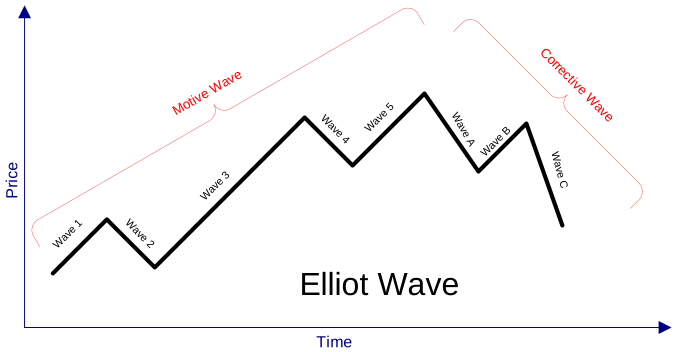
The subwaves have a fractal quality — each Elliot Wave is part of another Elliot Wave of the next higher degree, and is, itself, composed of Elliot Waves of the next lower degree. Specifically, each 2 adjacent subwaves of an Elliot Wave is composed of the 8 waves of the next lower degree, and those waves in turn are also composed of waves of the next lower degree, etc. So, in the above diagram, Wave 3 would be considered the motive wave of the next lesser degree wave, while Wave 4 would be the corrective wave of the next lesser degree wave.
When a wave moves in the same direction as the Elliot Wave in the next higher degree, it is called an actionary wave (aka trend wave); if it moves in the opposite direction, it is called a reactionary wave (aka countertrend wave).
Elliot Waves are actually much more complex than even the above discussion would imply. There are 6 specific rules that are considered inviolate — if they are not satisfied, then a wave cannot be considered an Elliot Wave. These basic inviolate rules are the following:
- Impulse waves move in the same general direction as the wave of the next higher degree.
- Impulse wave consists of 5 subwaves.
- Subwaves 1, 3, and 5 of the impulse wave are also impulse waves of 1 less degree, and subwaves 2 and 4 are corrective waves of 1 lesser degree.
- Subwaves 1 and 5 may have an impulse or diagonal pattern.
- Subwave 3 is always an impulse wave.
- In cash markets, within an impulse pattern, subwave 4 never overlaps subwave 1, but it may do so in futures markets.
Then there are guidelines, which may or may not be present or may vary in detail. An important quality of Elliot Waves is that while their form is specific, the amplitude and duration of the waves will vary, which greatly lessens their value as a forecasting tool.
The main practical application of Elliot Wave Theory is considered that it restricts the number of possible future paths of the market and that it allows an Elliottician to assess the relative probabilities of each path. Generally, the more guidelines that are satisfied by a particular path, the more likely it will occur.
Fibonacci Sequence and the Golden Ratio
Both Collins and Elliot had a fascination with the Fibonacci sequence and the golden ratio.
A Fibonacci sequence is formed by taking 2 numbers — any 2 numbers — and adding them together to form a 3rd number; then the 2nd and 3rd numbers are added again to form a 4th number, and this is continued to any desired length. The ratio of the last number over the penultimate number approaches 1.618, and this ratio can be found in many natural objects, and for this reason, this ratio is called the golden ratio. The golden ratio is actually an irrational number, like pi, and is often denoted by the Greek letter, phi (φ).
Elliot applied the Fibonacci relationships to Elliot Waves in 2 ways, by stating that:
- Corrective waves tend to retrace prior impulse waves of the same degree where the ratio of the corrective wave to the impulse wave was a Fibonacci ratio — most commonly 38%, 50%, and 62%.
- The length of the impulse waves that compose a higher degree wave tend to be in proportion to a ratio of the Fibonacci sequence.
Note that these relationships are not absolute, but that there is only a tendency to exhibit such relationships.