Collateralized Debt Obligations
A collateralized debt obligation (CDO) is a type of structured product that provides fixed-income securities with differing yields and risks, based on a pool of diversified debt instruments. It allows the issuance of securities with a higher credit rating than the securities used to back the CDOs, and part of the recent surge in the sale of CDOs have been to finance leveraged buyouts. CDOs were first created in 1987 by Drexel Burnham Lambert, a defunct dealer in junk bonds. CDOs were also 1 of the major types of securities severely downgraded during the 2007 - 2009 Great Recession, because they were based on subprime mortgages.
To see more clearly how CDOs works, consider this simple scenario:
- Take 2 $100 IOUs that each have an independent 90% probability of paying $100 and a 10% probability of default; each pays $5 of interest.
- Based on these IOUs, construct 2 derivative securities such that the more senior security pays the holder $100 unless both IOUs default and receives $3 of the interest if no more than one IOU defaults.
- The junior security holder will receive $100 if neither security defaults plus $7 of interest.
- By structuring the payouts according to this new derivatives contract,
- the senior security holder has only a 1% chance of not receiving payment of principal and interest (= .1 × .1 = .01 = 1%),
- while the junior security holder has a 81% (= .9 × .9 = .81) chance of receiving payment of both principal and interest and
- a 19% chance of not receiving repayment of principal
- = 1 − .81 = .19 = 19%
- a 19% chance of not receiving repayment of principal
- If only 1 IOU defaults, then
- the senior security holder still receives a full repayment of principal + $3 of interest,
- while the junior security holder receives the other $2 of interest from the non-defaulting IOU and no repayment of principal.
- Thus, the junior security pays a potentially higher yield to entice some investors to buy the riskier junior security.
Note that this simplified scenario ignores the cost of securitization. With CDOs, each security having a specific yield and risk profile are aggregated into different classes of securities called tranches.
A CDO is an asset-backed security (ABS) issued by a special purpose vehicle (SPV), which is a business entity or trust that was formed for the express purpose of issuing the CDOs, and can be backed by:
- investment-grade or high-yield corporate bonds;
- emerging market bonds;
- residential mortgage-backed securities (RMBS);
- commercial mortgage-backed securities (CMBS);
- other asset-backed securities;
- real estate investment trusts (REITs);
- bank loans, special situation loans and distressed debt;
- and even other CDOs.
CDOs differ from collateralized mortgage obligations (CMOs) primarily in providing differing amounts of credit quality grouped into 3 or more tranches with the same maturity. The senior tranches have the best credit quality and the lowest yield; the mezzanine tranches have slightly lower credit quality but a higher yield, and the subordinate or equity tranches (aka toxic tranches, toxic waste) receive residual payments, which is what is left over after the higher tranches have been paid. The equity tranches pay the highest yield, almost always more than 10%, but also have the greatest risk — in fact, these tranches have no credit rating and are the 1st tranches to suffer losses. A $500 million CDO will typically have at least $40 million in an equity tranche. The senior and mezzanine tranches have an investment-grade credit rating achieved by using credit enhancements, such as over-collateralization, where the underlying collateral is worth more than the CDO securities.
The equity tranche profits from interest rate arbitrage. The demand for asset-backed securities depends on supply and demand, just like everything else. Hence, a special purpose vehicle can sell it securities offering lower yields than what the underlying securities actually pay. The spread is paid to the equity tranche of the special purpose vehicle, whose profits accrue to the owners of the SPV.
CDOs can be classified by their underlying debt:
- Collateralized bond obligations (CBOs) are CDOs based on bonds or other CDOs, including:
- corporate bond-backed CDOs,
- emerging market-backed CDOs,
- and structured finance-backed CDOs, where the underlying assets are:
- mortgaged-backed securities (MBSs)
- residential
- commercial
- asset-backed securities,
- or real estate investment trust (REIT) debt.
- mortgaged-backed securities (MBSs)
- Collateralized loan obligations (CLOs) are CDOs based on bank loans. Many subprime loans were packaged and sold as CLOs.
CDOs can also be classified as cash CDOs and synthetic CDOs. Cash CDOs are backed by cash-market debt instruments, whereas synthetic CDOs are backed by other credit derivatives.
Cash and synthetic CDOs can also be classified by the goals of the sponsor. Balance-sheet CDOs allow the issuer, usually a bank, to lower its risk by removing assets from its balance sheet to the CDO. If banks have a legal minimum of reserve requirements, which is a specified percentage of its total assets, which earns little interest, then transferring some of its assets to a CDO lowers that requirement.
Arbitrage CDOs allow the issuer to profit from the spread between what the CDO yield that the issuer pays to investors and the interest received from the debt used to finance the collateral. The issuer also collects fees for managing the CDO, which usually ranges from 45 to 75 basis points of the CDO. Example: for a $500,000,000 CDO, a manager earning 50 basis points (= 1/2%) would collect $2.5 million annually.
Cash arbitrage CDOs also can be subdivided by the means of credit protection for the investors. The safety of the cash-flow CDO is backed by the current cash flow from the collateral, which is used to repay principal for maturing CDOs. The credit rating of a cash-flow CDO depends on the default rates of the collateral and the amount recovered. The safety of the market-value CDO is backed by the market value of its assets, which is liquidated to repay principal. Hence, credit ratings of the market-value CDO depend on the market value, price volatility, and liquidity of the underlying collateral. The 1st balance-sheet cash CDOs used a market-value credit structure, but since the 1990's, only cash-flow balance-sheet CDOs have been issued due to changes in the accounting rules.
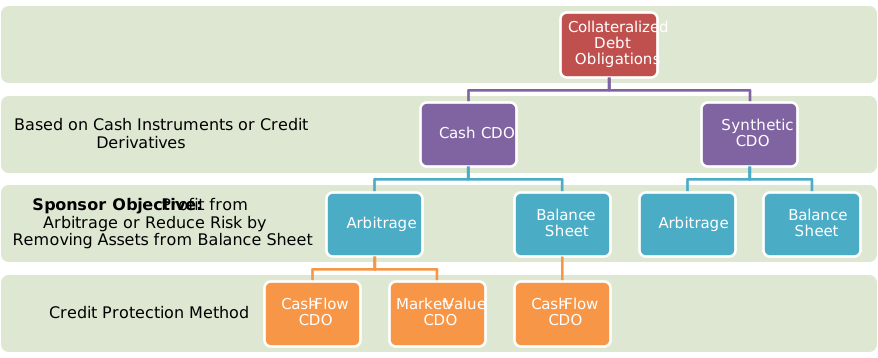
How a CDO is Created
A CDO is usually formed by a bank or other financial firm by setting up a SPV specifically for the CDO that is located offshore in locations that don't tax corporations, such as the Cayman Islands. A trustee, usually a bank, is chosen to manage the CDO and issues monthly reports on the debt composition of the CDO to its investors after it is established.
The CDO manager buys asset-backed securities for collateral, then sells commercial paper, which is short-term debt, to other financial institutions. The commercial paper is securitized by the top-rated tranches, which may constitute up to 90% of the CDO. Often, CDO managers have agreements with 1 or more banks to buy the commercial paper if there are no buyers in the marketplace.
To guarantee a good credit rating, the rating agencies — Fitch, Moody's, and S&P — help assemble the CDO by specifying the requirements for a top rating. The CDO manager consults and negotiates a credit rating for each tranche of the CDO. For the complexity of CDOs, rating agencies charge up to 3 times more money for rating CDOs than for rating bonds. With the close association of the rating agencies and the CDOs and the profits that rating agencies make from CDOs, many money managers believe that relying on credit ratings alone to assess the safety of CDOs is risky — it should be supported by scrutiny of the prospectuses and the monthly reports issued by the trustee. The cozy relationship between the credit rating agencies and the issuers of the CDOs have been uncovered by the 2007-2009 Great Recession, which demonstrated that the suspicions about the ratings of the CDOs were well justified.
CDOs as Investments
Though CDOs pay high yields, they have greater risks, even with an investment grade rating. Per this Bloomberg article, The Ratings Charade (webpage no longer available), CDOs with a Moody's investment grade rating of Baa had a 5-year default rate of 24%, while corporate bonds with the same rating had only an average 5-year default rate of 2.2% from 1983 - 2005. CDOs with a Ba rating had default rates of 25.3%.
CDOs are also almost impossible to value, and virtually impossible to even know what assets they are based on; however, it is becoming evident as many of them default, that a good portion of their assets consisted of subprime mortgages. Even more complex and risky are CDO squareds, which are composed of CDOs as the underlying asset, and CDO cubeds, which are composed of CDO squareds. Both CDO squareds and CDO cubeds contain thousands of mortgages with various risk profiles.
So that some of the equity tranches can be sold to pension funds, which cannot invest in securities without an investment grade rating, some CDOs have offered principal protection, which involves investing a portion of the money into zero coupon government bonds and the remaining portion in a CDO equity tranche. At maturity, if all is lost in the equity tranche, the principal remains when the zero coupon bonds mature. Of course, the fund will suffer a great opportunity cost since in such a scenario, no money was earned during the term of the investment.
CDOs Failed During the Great Recession Because Defaults Were Not Independent Events
The issuance of CDO securities relies on calculating default rates for the various pools of mortgages. It was natural to assume that default rates were independent events; otherwise, any calculations of the default rates for a pool of mortgages would be incorrect. While the default of a mortgage may not be directly related with that of another, their probability of default correlated through a common cause: how the mortgages were approved. Because lenders could pass their credit default risk onto the buyers of mortgage-backed securities, CDOs, and other securities based on mortgages, and because they earned income from originating and servicing the loans, they were motivated to originate as many loans as possible, which required that they extend loans to less creditworthy borrowers, often called subprime borrowers, which lenders were willing to do, because they did not have to hold any credit default risk. That virtually no covered bonds defaulted illustrates how the 2007 Great Recession would have been avoided if lenders were required to hold at least some of that credit default risk, as the issuers of covered bonds must do.
Historical Notes
Collateralized Debt Obligations were being Downgraded
During the Great Recession in 2008, the credit ratings of certain collateralized debt obligations were downgraded for the increasing delinquency rate of subprime mortgages. About 40% of CDOs consisted of residential mortgage-backed securities, and 3/4 of that consisted of subprime loans and home-equity loans, which had a lower lien status. Predictions were being made that CDOs will experience significant losses if home prices continued to depreciate, which was expected to continue at least until 2008, and, in fact, has actually continued until 2012.
Much of the subprime trouble was caused by mortgage fraud and falsifications in credit reports. Thus, credit scores, loan-to-value ratios, and ownership status were less reliable as indicators of creditworthiness, so S&P, which rates many CDO issues, changed its methodology. One change was to require greater credit enhancements for higher-rated tranches to prevent being downgraded if lower tranches in the same issue were downgraded.
A CDO issue divides its MBSs into different tranches, or classes, with different risk profiles. Lower credit-rated mortgages compose the lower tranches, which gives a higher credit quality to the upper tranches. However, all tranches must be sold, or the CDO cannot be issued. Thus, the lower credit ratings of the lower tranches may decrease the number of CDOs that can be sold, which, in turn, will decrease the number of mortgages that can be sold, which will increase mortgage rates for all borrowers.