Insurance Companies
Insurance companies provide insurance by collecting premiums from policyholders and indemnifying those policyholders for covered losses that they suffered during the policy period. Because the actual cost of their product is unknown before the policy period elapses, they must estimate their costs, usually with statistics and historical analysis. For the nature of their product, insurers must perform common functions unique in providing their product: production, ratemaking, underwriting, loss adjustment, and investment.
- The production department (a.k.a. agency department) of an insurance company is its sales and marketing division. The production department hires and manages salespeople and also assists them in technical aspects of their products. Special agents act as intermediaries between the production department and the outside agents.
- Ratemaking is determining the rates to charge per unit of covered exposure that will adequately cover losses, pay company expenses, and earn a profit.
- Underwriting is selecting and classifying exposures so that the proper rate can be charged and to avoid adverse selection. Riskier applicants may be rejected. Because rates are based on classes of exposures, improper classification of insurance applicants will result in the wrong rates being applied, which may result in losses to the insurance company.
- Loss adjustment is investigating losses and paying legitimate claims while avoiding paying fraudulent claims or overpaying claims.
- Investments reduce the cost of insurance by investing the premiums paid by the insured to earn a return before they are paid out for a claim.
Insurance companies also have other departments common to other companies, such as legal and accounting. Property and liability insurers also have an engineering department whose main purpose is to inspect premises to determine their insurability and at what rate. They may also recommend methods to the insured to lower their potential losses.
In the past, insurance companies were largely restricted to selling insurance products, but since the passage of the Financial Modernization Act (aka Gramm-Leach-Bliley Act (GLB), Financial Services Reform Act of 1999) in November, 1999, insurance companies have expanded their offerings to include stocks and mutual funds, and other financial services and products. The Financial Modernization Act has accelerated consolidation, where larger companies are buying up smaller companies, and has allowed convergence — banks, brokerages, and insurers can now sell a wide variety of financial products that, before the Act, were restricted according to the financial institution. For instance, banks can now sell insurance and insurers can sell mutual funds.
However, most of these combinations selling different lines of insurance must be organized as holding companies, and firewalls must be set up between the different companies within a holding company to prevent the transference of funds among the companies.
Classification of Insurance Companies
Insurance companies may be classified by the type of insurance that they sell, their licensing status, their legal organization and form of ownership, by their marketing system, or by the type of provider. The 2 major categories of insurance according to type of provider is private insurance, which is provided by nongovernmental organizations, and government insurance, provided by a government or one of its agencies. Government insurance includes compulsory insurance such as Social Security and Medicare for senior citizens, and specialized insurance programs, such as mortgage loan insurance. Most government insurance programs were designed to provide for the special needs of its citizens or to further a desirable social goal, such as promoting homeownership. Unlike private insurance, government insurance is not undertaken for profit. Indeed, government insurance programs, such as Social Security and Medicare, constitute a major cost of the government.
Classification by Insurance Type
Private insurance companies are categorized per the type of insurance they sell:
- life and health insurance companies
- property and casualty insurance companies
Many insurance companies specialize in a particular line of insurance, but most of these are property and casualty insurance companies, such as marine insurance, auto and homeowners insurance, and surety and fidelity bonds.
Classification by Domicile: Domestic, Foreign, and Alien Insurers
Most insurance companies are formed or created under the laws of 1 state, but they may do business in other states. Likewise, insurance companies based in other countries may also do business within the United States. Because state law largely governs the operations of insurance companies and what they may offer in particular geographical areas, specific terms distinguish the different types of insurer according to where they do business relative to where they were formed.
A domestic insurer sells insurance in the same state that it was chartered or incorporated, which is its domicile. A foreign insurer is operating in a state outside its domicile. An alien insurer sells insurance within the state, but is domiciled in another country. Foreign and alien insurers are usually licensed within the state in which they sell the insurance, even if they are not domiciled there; otherwise, their insurance can only be sold as a surplus line through the services of a surplus lines broker.
Classification by Licensing: Admitted and Non-Admitted Insurers
A licensed or admitted insurer is licensed by the state to sell insurance in that state, which may include foreign or alien insurance companies. An unlicensed or non-admitted insurer is not licensed to do business within the state, though it may be able sell insurance as a surplus line, when the domestic insurers within the state do not offer coverage for particular types of risks. Generally, insurance agents are only allowed to sell insurance from admitted insurers, but insurance can be placed with non-admitted insurance companies through the services of a surplus lines broker, who is a broker licensed by the state to place insurance with non-admitted insurers for businesses and other organizations with risks not covered by admitted insurers.
Non-admitted insurers are much more prevalent in states with frequent natural disasters, such as California, Louisiana, and Florida, and other southeastern states since they are more lightly regulated and they are willing to provide coverage that admitted insurers are unwilling to cover, especially after major disasters when many insurance companies drop coverage for high-risk groups. For instance, many homeowners lost their home insurance after hurricanes and tornadoes in some southeastern states and after major fires in California. Non-admitted insurers charge higher prices, and there is less regulation of their contracts, so they can provide less coverage.
However, non-admitted insurers have more risk. They do not have to contribute money to a guaranty fund, so they are not insured by the state against insolvency, so insured claims may not be covered. They often have a low risk-based capital (RBC) ratio, so they may not be able to cover large losses that may result from widespread events, such as hurricanes. The RBC ratio of admitted insurers usually exceeds 10, whereas non-admitted insurers may have an RBC ratio of less than 2.
Many non-admitted insurers have no rating from top raters, like AM Best. They may have ratings from less reputable rating agencies, but their ratings are considered less reliable.
For financing, non-admitted insurers rely more on surplus notes, reinsurance, and reciprocal exchanges.
The Legal Organization and Ownership of Insurance Companies
Insurance companies are also commonly classified per their legal organization and form of ownership.
Multiple-line insurers sell multiple lines of insurance, such as liability, fire, and automobile insurance. However, with the public's interest in maintaining the solvency of insurers, state laws prevent an insurance company or other financial institution from selling both life, and property and liability insurance — those that do are organized as holding companies, which have both a life insurance company and a property and liability company.
The most important distinction among insurance companies is that they are either stock insurance companies, which are owned by stockholders, or mutual insurance companies, which are nonprofit corporations owned by the policyowners.
A stock company is a corporation with stockholders that participate in the gains and losses of the corporation. Like other stockholders, they have the right to vote and to elect the board of directors. The stock company's charter specifies what types of insurance that it will sell.
Most stock companies sell property and liability policies; some states allow stock companies to also sell life and health insurance. A stock company cannot issue an assessable policy, which is a policy that permits the insurer to charge additional premiums if losses are excessive. Stockholders bear the losses, but they also have the potential to gain through dividends or share price increases.
Mutual insurers are corporations owned by the policyowners, who elect the board of directors. The board of directors appoints the executives who run the mutual company. Mutual insurance companies cannot raise money by issuing stock, but they can raise some capital by selling surplus notes, which are unsecured debt, subordinate to both other debt and to obligations to policyholders, that adds to the insurer's surplus, and interest payments are tax-deductible.
Policyowners may either receive a dividend or get an advance reduction in premiums. Life insurers will generally pay a dividend only if the mortality experience has been better than anticipated, in which case, the dividends are a return of premium and are not taxable.
Mutual insurers are further categorized into these types:
- assessment mutual,
- advance premium mutual,
- factory mutual,
- fraternal mutual.
An assessment mutual has the right to charge more premiums if losses and expenses exceed expectations. Since this arrangement puts more risk on policyholders and may be difficult to collect, few mutual insurers are organized as assessment mutuals, and those that are sell only a few policies in a limited geography.
Advance premium mutuals are like an assessment mutual in that the company is owned by the policyowners, but the advance premium mutual cannot charge assessments if losses exceed expectation, but pays for excessive losses out of its surplus, the difference between its assets and its liabilities. To cover losses, the advance premium mutual charges a greater premium than is necessary to cover its losses — hence, its name — and returns excess to the policyowner at the end of the period as a dividend. Many life insurers are organized as advance premium mutuals.
The factory mutual is a commercial property insurer that insures only those sites that meet its rigid safety and construction qualifications — what risk managers call a highly protected risk (HPR). The factory mutual, so called because it insures mostly factories and other industrial sites, inspects all sites regularly, and offers loss control services to reduce risk. The loss control information has been garnered from over a century of investigating losses on the properties of the insured. The factory mutual even sends teams to investigate losses on noninsured sites to learn more about how losses occur. Lower rates may be offered to those insureds who meet its qualifications and follow its advice.
Fraternal insurers are mutual companies that provide life and health insurance to members of a social or religious organization, such as the Knights of Columbus or the Aid Association for Lutherans. As charitable organizations, fraternal insurers pay no federal income or state premium tax.
Perpetual mutuals, which provided mainly homeowner's insurance, now has only historical significance since the last one dissolved in 2004. Perpetual mutuals charged a single premium or a lump sum that covered a long time. The money was invested to cover losses. If an insured canceled his policy, part of the premium was returned.
Reciprocal Exchanges
A reciprocal exchange (a.k.a. interinsurance exchange) is a private unincorporated mutual insurer consisting of members who insure each other. Each member insures every other member — hence, the name. A reciprocal exchange, constituting only a small part of the insurance market, mostly provides property insurance, particularly auto insurance. Some risk retention groups operate as reciprocal exchanges.
The exchange is managed by an attorney-in-fact, which is usually a corporation that manages the insurance operation, including marketing, paying losses, handling reinsurance, and collecting premiums. However, the members of the reciprocal exchange are the insurer — not the attorney-in-fact. The attorney-in-fact has no liability for losses; it is simply hired to manage the insurance operation.
A pure reciprocal exchange maintains separate accounts for each member, crediting each account with the member's premiums and earnings, and debiting the account for losses and expenses. A member who cancels the insurance receives the account value.
A modified reciprocal exchange does not maintain separate member accounts but is run more as an advance premium mutual, which is managed by an attorney-in-fact.
Demutualization
A primary effect of the Financial Modernization Act was to increase mergers among insurers — insurance companies either acquired other companies to expand their business, or were acquired. While a stock insurance company can easily engage in mergers, a mutual company cannot, so, to remain competitive with banks, brokerages, and other insurers, many mutual companies demutualized — converted their legal organization from a mutual company to a stock company.
Demutualization requires the approval of the policyowners and the state insurance department, generally taking 18 to 24 months to complete. Policyowners may receive stock or cash options, whose value will be commensurate with the total premiums paid by the policyowner. If stock is issued, the number of shares received by each policyholder depends on the stock's initial public offering price.
However, many policyowners of former mutual companies were dissatisfied with the demutualization. The board of directors of many of these demutualizations have changed the policyowners' ownership rights into membership rights, with many policyholders receiving less than the value of their ownership rights in the process. Nonetheless, demutualizations will continue.
A stock company has much greater capital flexibility than a mutual. If a stock company needs more money to expand business, to form subsidiaries or holding companies, or needs to cover excessive losses, it can sell common and preferred stock or issue bonds. A mutual company can only rely on its surplus or premiums charged to its members.
A stock company could also issue stock options to its key employees, to attract and keep more talent. Moreover, the Deficit Reduction Act of 1984 limited the tax deduction of dividends paid by mutual companies.
Demutualization is done in 3 ways:
- In a pure conversion, the mutual company amends its charter to become a stock company, and issues stock to its policyholders.
- A mutual company can also use bulk reinsurance. The mutual company organizes or acquires a stock company, then cedes all its policies to the stock company. After all assets and liabilities of the mutual are transferred to the stock company, the mutual company is dissolved.
- A mutual company can also merge with a stock company, with the merger continuing as a stock company.
Another form of demutualization that is legal only in Illinois and Pennsylvania is through the issuance of nontransferable subscription rights to the policyholders. Subscription rights give the policyholder the right to buy a specified number of shares in the new stock company for a specified price, but the subscription rights must be exercised when the stock is first offered to the public. The time period for the subscription rights is determined by state statute. The value of the subscription rights is commensurate with the policyholder's ownership interest in the mutual company.
Health Expense Associations
Health expense associations are nonprofit associations unique to health insurance, in that they provide health care in exchange for the premium payment rather than reimbursing the policyholder for claims, as most other insurance companies do. The most common health expense associations are Blue Cross and Blue Shield and HMOs.
Health expense associations became possible when states enacted laws that allowed their formation. Blue Cross was organized by hospitals to provide semiprivate hospital beds, and Blue Shield was organized by physicians associations to provide the services of its member physicians. The premium served as a pre-payment for their services. Likewise, health maintenance organizations (HMOs) also provide services for a monthly premium, called the capitation payment.
Mutual Holding Company (MHC)
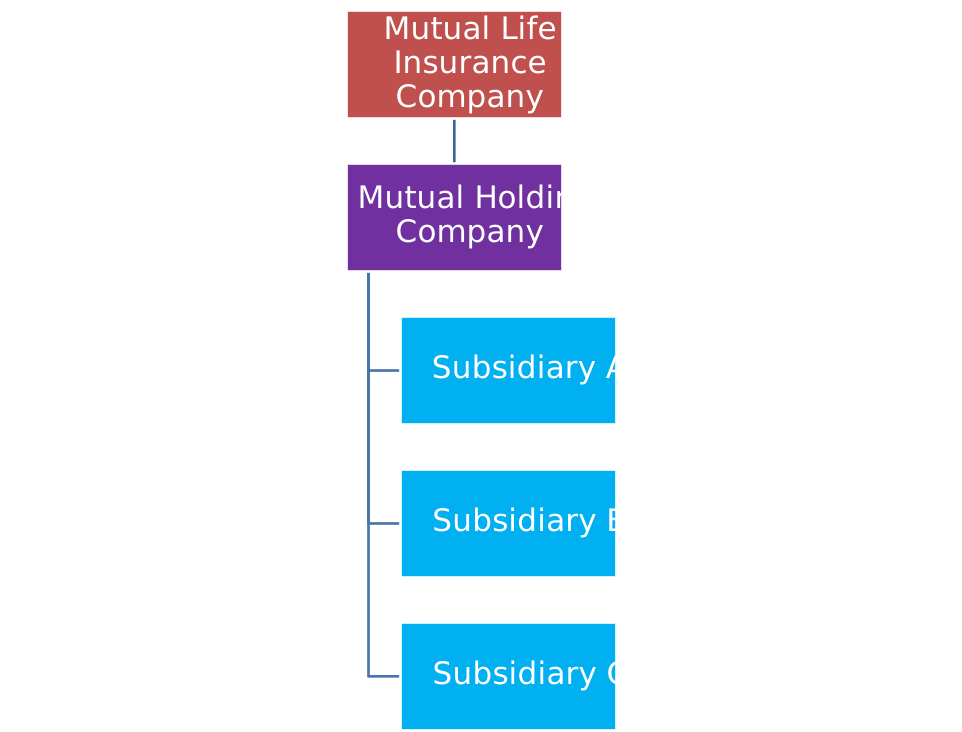
State regulations require a mutual to get approval from the state insurance department before it can demutualize. Demutualization is expensive, and generally takes from 18 to 24 months to complete. As an alternative, some states allow mutual companies to form holding companies, which can own and direct other companies. The mutual holding company gains the benefits of stock companies by buying them or forming them as subsidiaries, which can sell different lines of insurance, including life and property and liability insurance.
Often, the mutual holding company retains at least 51% ownership of any subsidiaries that issue stock so that the proceeds do not have to be passed to policyholders of the mutual company — a clear disadvantage for the policyholders. Furthermore, policyholders have no voting rights in the holding company, leaving the management of the company unaccountable to the policyholders.
Lloyd's of London
Lloyd's of London is not an insurance company, but a large insurance marketplace, where underwriters meet with buyers of insurance or their brokers to create an insurance agreement. The buyers and sellers — often called Names — negotiate terms and price. Underwriting syndicates were restricted to individuals until recently. Now, corporations, including insurance companies, can become Names and sell insurance through Lloyd's.
Each underwriting syndicate is a separate legal entity, and is responsible for all losses for the insurance that it sells. The General Insurance Standards Council of Lloyd's audits each underwriter annually. All premiums for the 1st 3 years are paid into a premium trust fund. Losses and expenses are deducted from the fund. After 3 years, profits are distributed to the underwriters, or they are assessed a deficiency which they must pay.
The main types of insurance sold through Lloyd's are automobile, aviation, marine, property and liability.
New Developments
Demutualization Income may not be Taxable
When an insurance company demutualizes, it pays cash and stock to its former members to compensate them for the loss of their ownership interest. For years, the IRS has taxed the entire amount, claiming that the shareholders of the former mutual fund companies didn't pay for the shares. However, a single accountant, Charles Ulrich, has disputed this claim, correctly pointing out that the shareholders paid for their shares and cash payments with the premiums that they paid to the mutual fund companies. In a rare victory of an individual against the IRS, the courts have agreed with him. The IRS may appeal this decision to a higher court, but, usually, it is simpler giving refunds to those who apply for it. A policyholder must apply for the refund within 3 years of the tax deadline for the year in which the distribution was received. If the IRS refuses the request for refund, and it may for larger refunds, the taxpayer at least extends the deadline for another 2 years with the request.
7 Years Later, Lone Accountant Beats IRS, MSNBC.com
How Insurance Companies are Increasing Profits by Paying Less in Claims
Per this Bloomberg article, The Insurance Hoax, property and casualty insurance companies were making record profits in the current millennium, even during a time of major natural catastrophes, such as Katrina and the California wildfires, by reducing claims payments. Insurers are offering lowball settlements, and if the property owners refuse, then they take them to court. Central to their method of reducing claim payments is using software to estimate their cost. Colossus, developed by Computer Sciences Corporation, estimates the cost of auto accidents, including the cost of pain and suffering, and permanent disability. Xactimate, by Xactware Solutions, Inc., has developed software that estimates the cost of rebuilding a home. However, many are contending that these programs are underestimating the true costs of claims. Farmers Group, a subsidiary of Zurich Financial Services AG, has stopped using Colossus due to a class-action lawsuit that claimed that Colossus was underestimating the true costs of injuries.
Other ways that insurance companies were reducing claim payouts was by changing policies, with the changes applying retroactively, and altering the engineering reports of the people who had actually inspected the damage. Many of these engineering companies depend on the business from the insurance companies, and, so when the insurance companies pressure the groups to lower cost estimates, they often comply.