Law of Large Numbers
Insurance companies must determine what premium to charge that will cover losses, and be competitive with other insurance companies. To do this, insurance companies hire actuaries, who use statistics and the law of large numbers to determine expected losses and the probability of how much actual losses can deviate from expected losses.
Probability and Statistics
Sometimes, the probability of an event can be determined a priori. Such is the case with the flip of a fair coin, or the roll of a fair die, because the possibilities are both limited and known. However, the probability of most insurable events cannot be known a priori, because too many factors influence the outcome, resulting in highly variable outcomes. Thus, actuaries apply statistical analysis to past events to determine the frequency of losses and the extent of those losses within a population, and how much they vary from year to year.
A probability distribution summarizes this data by plotting possible events against their probabilities. If the possibilities are limited, the distribution is said to be discrete; otherwise, it is continuous. With only 6 possibilities, plotting the roll of a die creates a discrete probability distribution. However, most insurable events have a continuous distribution because the outcomes have a continuous range of possibilities.
A probability distribution can be characterized by its central tendency and its dispersion. Central tendency is the expected value, or mean (common symbol: μ) of the distribution, equal to the sum of each possible event (X) times the probability (P) of that event. In the case for insurable losses, the mean = the sum of the amount of each possible loss times the probability of that loss.
Equation for Mean: μ = ∑ Xi Pi
Example: Calculating the Mean of 2 Samples of 3 Events
| Amount of Loss (Xi) | Probability of Loss (Pi) | XiPi | ||
|---|---|---|---|---|
| $0 | × | .10 | = | $0 |
| $500 | × | .20 | = | $100 |
| $1,000 | × | .05 | = | $50 |
| μ | = | ∑ Xi Pi | = | $150 |
| Amount of Loss (Xi) | Probability of Loss (Pi) | XiPi | ||
|---|---|---|---|---|
| $100 | × | .15 | = | $15 |
| $500 | × | .20 | = | $100 |
| $1,000 | × | .035 | = | $35 |
| μ | = | ∑ Xi Pi | = | $150 |
However, the mean does not measure dispersion, which measures how widely the individual events vary. A measure of dispersion is important because, in determining risk for insurance purposes, because a greater dispersion means a greater range of losses, and, thus, greater objective risk. Wide variations in dispersion can average to the same mean, as can be seen in the 2 tables above. Both have the same mean of $150, but the losses in the 1st table has a greater dispersion that varies from $0 to $100, and in the 2nd table, the losses vary from $15 to $100. Because the range is more limited in the 2nd example, it poses less objective risk, and is, therefore, more predictable.
The statistical measure of dispersion is the variance (common symbol: σ2), equal to the square of the difference between the possible values and the mean.
Equation for Variance: σ2 = ∑ Pi(Xi − μ)2
To make the units of central tendency and variance the same, the square root of the variance, called the standard deviation (common symbol: σ), is used to represent dispersion.
Example: Calculating the Variance and Standard Deviation of the Above 2 Samples
For the 1st distribution, the variance and standard deviation are:
- σ2
- = .1(0 − 150)2 + .2(500 − 150)2 + .05(1,000 − 150)2
- = 2,250 + 24,500 + 36,125
- = 62,875
- σ = √62,875 = 250.75 (rounded)
For the 2nd distribution:
- σ2
- = .15(100 − 150)2 + .2(500 − 150)2 + .035(1,000 − 150)2
- = 375 + 24,500 + 25,287.5
- = 50,162.5
- σ = √50,162.5 = 223.97 (rounded).
A greater standard deviation for a loss event, such as fires, indicates a greater uncertainty of the event within a given time frame, and, therefore, the greater the potential for losses. However, the standard deviation can only be calculated from an observed population or a representative sample. The law of large numbers is useful because the standard deviation declines as the size of the population or sample increases, for the same reason that the number of heads in 1 million flips of a coin will likely be closer to the mean than 10 flips of a coin.
Central Limit Theorem
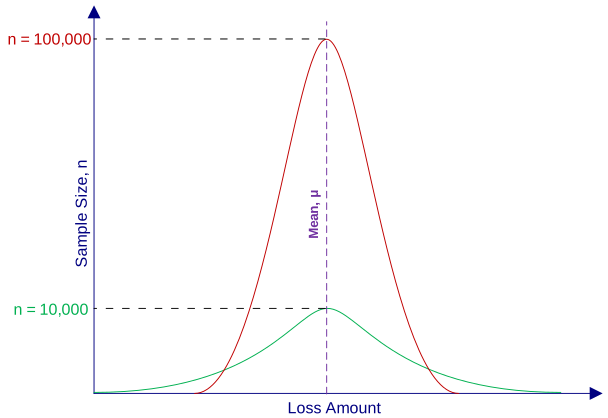
The central limit theorem states that as the sample size (n) grows, the distribution becomes more like the normal distribution of the entire population, with the mean of the sample more nearly equal to the mean of the population, and the standard error (σs), which is the standard deviation of the sample, approaches the standard deviation of the population (σp).
Equation for Standard Error: σs = σp/√n
Thus, the difference between the standard error and the standard deviation of the population diminishes as the sample size, n, increases.
The normal distribution is represented by the bell-shaped curve, with 68% of the distribution lying within 1 standard deviation, 95% lying within 2 standard deviations, and 99.7% of the distribution lying within 3 standard deviations.
Underwriting Risk and Insurance Premiums
When an insurance company increases the size of its customer base, it increases its underwriting risk because the sample size is greater, and, therefore, there is a greater chance of loss. But the company also collects more premiums to finance those losses. In fact, premiums grow faster than the underwriting risk, because the underwriting risk = the square root of n times the standard deviation for the population, and, thus, increases by the square root of the sample size, n, but the premiums grow by n.
Underwriting Risk
- = n × σs
- = n × σp/√n
- = √n × σp
Premiums Collected = n × Amount of Premium
Insurance companies expect losses — that's their business, but, by increasing the customer base, actual losses more closely equal expected losses, thus, reducing objective risk, which allows insurance companies to charge a premium that covers losses and operating expenses, and that provides a profit, but no more.
Note, also, that because dispersion increases with smaller sample sizes or populations, to set an accurate premium, the probabilities calculated from samples or populations must be applied to insured groups at least as large as the samples used to estimate probabilities. If the insured group is smaller than the samples, then dispersion will be greater, which may cause greater losses for the insurance company and cause greater variability of losses from year to year.
Some insurance premiums cannot be calculated using the law of large numbers. Because catastrophes are infrequent and highly variable, catastrophe insurance cannot use the law of large numbers. Instead, catastrophe insurance relies on statistical models to forecast disasters and transfers much of its risk to investors by selling catastrophe bonds, contingent surplus notes, and even exchange-traded options. Most catastrophe insurance is provided by reinsurance companies, because they generally cover a much larger geographic area.
The Law of Large Numbers Helps Avoid Credit Risks and Maintains Stable Premiums
The law of large numbers is useful to insurance companies because they charge a premium to cover losses before they occur. If the insurance company could charge the premium after the covered period, then the premium charged could reflect actual losses. Likewise, if a group decided to pool its losses among the group, then the law of large numbers would not be needed since the cost of the group's losses could be distributed to each member of the group. The disadvantage of this approach is that there is significant credit risk, in that many members of the group may decide not to pay. The other disadvantage is that premiums would be much more volatile, especially for smaller groups.
Hence, the main benefits of using the law of large numbers to insure a group is to avoid credit risk by charging a premium that reflects probable losses before the losses occur and to charge a more stable premium.