Put-Call Parity
A portfolio consisting of stock and a protective put on the stock establishes a minimum value for the portfolio that also has an unlimited upside potential. If the stock declines below the strike of the put, the put increases in value by a dollar for every dollar decline of the stock below the strike price. If the stock climbs above the strike price, the put expires worthless, leaving only the stock. An equivalent portfolio can be established by buying a call and a risk-free T-bill that matures on the expiration day of the call. Because a portfolio that has a minimum value but unlimited upside potential can be established using either a put or a call, then they must be equivalent, because if they weren't, then arbitrageurs could take advantage of the price discrepancy, writing one option and buying the other until equivalence was achieved.
Consider a portfolio that has 1 call with a strike price of $100 that expires in 6 months, and a T-bill with a face value of $10,000, bought at a discount, that matures on the call's expiration day. If the call is in the money, then the $10,000 from the T-bill can be used to purchase the 100 shares of stock at the strike price, resulting in a portfolio value equal to 100 shares of stock. If the call expires worthless, then the portfolio is worth $10,000 from the T-bill. Thus, the minimum portfolio value is $10,000.
Similarly, the portfolio consisting of stock and a protective put would have as its minimum value the strike price of the put. Thus, if the 2 portfolios provide equal values, then they should cost the same to establish — otherwise, arbitrageurs would profit from the difference until the difference fell below trading costs, buying 1 option and selling the other. Arbitrageurs would not have much effect on the stock price or the interest rate of the T-bill, but they would have an effect on the prices of the options, and it is this effect that would equilibrate the prices. Thus, the stock + put must = the T-bill + call. This leads to the following equation, called the put-call parity theorem:
| C | + | x/(1+i)t | = | S0 | + | P |
| C = Call Premium x = Call Strike = Face Value of T-bill i = annual interest rate t = number of years S0 = Initial Stock Price P = Put Premium x/(1+i)t = Present Value of Strike Price Conditions: Options are not exercised before expiration day, | ||||||
The equivalence of this equation can be seen in the following 2 graphs of each portfolio:
T-bill + Call = Put + Stock
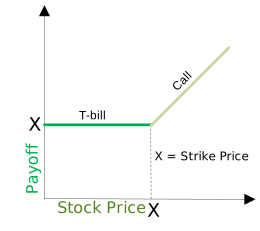
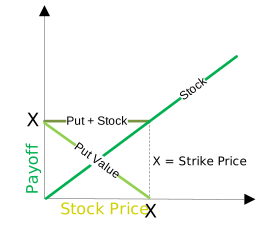
This relationship assumes that no dividends are paid by the stock before expiration of the put or call. However, the put-call parity equation can be extended to include dividends, if the options are European style or are held to maturity:
| P = C - S0 + x/(1+i)t + d/(1+i)t |
| By transposition of the above equation: |
| C = P + S0 − x/(1+i)t − d/(1+i)t |
| P = Put Premium C = Call Premium S0 = Initial Stock Price x = Strike Price d = Stock Dividend t = number of years x/(1+i)t = Present Value of Strike Price d/(1+i)t = Present Value of Dividend Condition: Options are not exercised before expiration day. |
Note that if the stock pays no dividends before expiration, then this equation is equivalent to the equation for the put-call parity. It can also be seen clearly in this equation that dividends increase the put premiums and decrease call premiums.
These equations assume that the options are not exercised before expiration; otherwise, the payoff of the portfolios will probably differ.
Example 1 — Verifying the Put-Call Parity with Real Prices
On November 18, 2006, market data yielded the following information on Microsoft (MSFT), with the 2 options having a strike price of $30 and that expired 2 months later, in January, 2007:
Stock Price = $29.40
MSFT Put bid/ask = $0.90/$1.00 = $0.95 average price.
MSFT Call bid/ask: $0.80/$0.85 = $0.825 average price.
Lowest Margin Interest (that I could find): 8%
Substituting the above numbers into the put-call parity equation and using the average prices of the put and call, and using 1/6 of a year = 2 months, we get:
.0825 + 30/(1.08)1/6 = 29.40 + .95
30.44 ≈ 30.35
As you can see, the 2 sides of the equation are well within even an arbitrageur's trading costs.
Example 2 — Conversion Arbitrage - Profiting from an Overpriced Call
Let us suppose that, in the above example, the call was selling for $1.80 instead of $0.80. We can then profit from what is known as conversion arbitrage. We sell the left hand of the equation and buy the right for an immediate profit. Note that the profit is the same regardless of what the stock price is on expiration — thus, this is risk-free arbitrage.
| Position | Immediate Payoff | Cash Flow in 2 months | |
|---|---|---|---|
| St = Stock Price at expiration. | St ≤ 30 | St > 30 | |
| Borrow $30/(1.08)1/6 = 29.62 | +29.62 | -30 | -30 |
| Buy Stock | -29.40 | St | St |
| Write (sell) call | +1.80 | 0 | 30 - St |
| Buy put | -1.00 | 30 - St | 0 |
| Total= | $1.02/share | 0 | 0 |
Example 3 — Reverse Conversion Arbitrage - Profiting from an Overpriced Put
Let's change the put value in Example 1 to 1.85, so that it is now overpriced. This arbitrage is called a reverse conversion, because it is the reverse of a conversion. Now we want to buy the left side of the put-call parity equation and sell the right side. Note that the call covers the shorted stock if the stock rises above the strike, and the put is covered by the shorted stock, if the stock price is less than the strike, which explains St - 30. For instance, if the stock price is $20 on expiration day, the liability from the put is $10 which is mostly covered by the profit of $9.40 from the shorted stock.
| Position | Immediate Payoff | Cash Flow in 2 months | |
|---|---|---|---|
| St = Stock Price at expiration. | St ≤ 30 | St > 30 | |
| Sell Stock Short | + 29.40 | - St | - St |
| Buy Discounted Note for PV(30) | - 29.62 | + 30 | + 30 |
| Buy call | - 0.85 | 0 | St - 30 |
| Write (sell) put | + 1.85 | St - 30 | 0 |
| Total= | $0.78/share | 0 | 0 |
The put-call parity is used to determine the theoretical price of a put from the Black-Scholes formula, a widely used method to determine the theoretical price of calls..