Foreclosure
When a borrower defaults on a mortgage or deed of trust, or fails to fulfill other contract provisions, the lender can initiate foreclosure, a legal procedure allowing the lender to sell the property used as security to pay off the debt. Most foreclosed properties are sold at auction. In states that use deeds of trust instead of mortgages, auction sales for foreclosed properties are often called trustee sales since the trustee sells the property for the lender. When foreclosed property is sold, any money remaining over the loan payoff + costs and penalties + selling costs are returned to the borrower. Title is transferred to either the lender or to a 3rd party who purchases the property in a foreclosure sale. The lender pays any tax liens on the property, and the foreclosure process removes all other liens, including junior liens on the property, giving the lender a clear title to the property. Since most property lenders are banks, property held by banks through foreclosure are called bank-owned properties, or real estate owned properties, usually abbreviated as REO properties. Banks end up owning properties because, at auctions, they set the minimum bid for what is owed, including the mortgage amount + costs and penalties + arrears. Properties on which the minimum bid exceeds the property value rarely sell, so the banks retain possession. Eventually banks must sell the foreclosed properties at lower prices commensurate with their value; otherwise, holding costs, such as insurance and real estate taxes, will accrue.
To avoid the time and expense of foreclosure and the possible holding costs of REO properties, banks often agree to a short sale of the underwater property, where the property value is less than the remaining debt secured by that property. In a short sale, the borrower sells to a buyer willing to pay at least the property value. A lender will more likely agree to a short sale if the borrower cannot continue payments and the property is underwater.
Types of Foreclosure
There are 3 methods of foreclosure. Which method is available depends upon the loan contract and the state.
Judicial Foreclosure
A judicial foreclosure is a sale approved by the court and is used when a mortgage is the underlying debt instrument for the property. The holder of the mortgage, called the mortgagee, notifies the borrower, called the mortgagor, who also has the title of the property, of the deficiency, or other breach of contract. If the borrower does not respond satisfactorily, the lender will accelerate the loan, entitling the lender to the full amount of the loan + costs immediately. If the borrower fails to pay the accelerated amount, the lender goes to court to get approval for the sale of the property, then advertises the sale in local media to sell in an auction. A lis pendens (suit pending) notice is filed with the county recorder to notify any interested parties of the pending lawsuit.
Nonjudicial Foreclosure
Some states require or allow using a dead of trust instead of a mortgage to protect the lender of money for property. Often called a nonjudicial foreclosure (aka statutory foreclosure), the title is held by a 3rd party — the trustee. The deed of trust has a power-of-sale-clause that allows the sale of the property without going to court in the event of a default. Statutory foreclosure is carried out according to state law and the contract for the purchase of the property. If the borrower defaults, the lender notifies the trustee of the default. The trustee may have to record a notice of default at the county recorder's office to notify the public about the impending auction. The auction is also advertised in the local media, listing, among other things, the total amount due on the property. After the property is sold, an affidavit of foreclosure may have to be filed. The lender will usually submit a bid equal to the amount due on the loan + the foreclosure costs to ensure that its cost will be covered by another bidder; otherwise, the lender will receive legal title to the property.
Strict Foreclosure
In some states, a lender may get title to the foreclosed property without any sale through strict foreclosure. When the borrower defaults, the lender asks the court to order the borrower to pay off the loan. The court sets a specific date by which the borrower must comply. If the borrower fails to pay, the court simply awards full legal title of the property to the lender.
Deficiency Judgment
If the foreclosure sale does not pay off the loan, including accrued interest and sale costs, the lender may also get a deficiency judgment for the difference. A deficiency judgment can also be obtained against any guarantors of the debt or against any owners who assumed the debt by contract.
However, any amount above the loan amount + costs is returned to the borrower.
Deed in Lieu of Foreclosure
A borrower may prevent foreclosure by simply giving the lender the title of the property. If the lender accepts, the borrower can transfer the title to the lender, eliminating the need of foreclosure — thus, it is called a deed in lieu of foreclosure (aka friendly foreclosure, deed-in-lieu), because it is agreed to by the lender and borrower. The borrower is released from the debt and avoids a deficiency judgment. Another advantage to the borrower is that a deed in lieu of foreclosure is less damaging to his credit score than a regular foreclosure. The advantages to the lender are the savings in the time and expense of a foreclosure, and the lender is more likely to receive the property in better condition.
While expedient, a deed in lieu of foreclosure has disadvantages for both borrower and lender. The main disadvantage for the borrower is that it is listed as a negative item in his credit report. The main disadvantage to the lender is that the property still has all junior liens attached, whereas in a regular foreclosure, all junior liens are eliminated. The lender will also lose any rights under FHA and VA guarantees, and will not receive any payment from any mortgage insurance that the borrower may have had.
Redemption
A borrower may still be able to keep his property after a default through the process of redemption. However, there is no redemption period in these states: Colorado, Delaware, Florida, Georgia, Hawaii, Indiana, Louisiana, Massachusetts, Mississippi, Montana, Nebraska, Nevada, New Hampshire, New York, North Carolina, Ohio, Oklahoma, Pennsylvania, Rhode Island, South Carolina, Texas, Virginia, Washington, Washington DC, West Virginia.
Most states give the borrower an equitable right of redemption, which must occur before the foreclosure sale. If the borrower pays all arrearages + costs, then the loan will be reinstated. In some states, however, the borrower may have to pay the entire accelerated amount. If the entire amount is due and the borrower is unable to pay it, then another person may redeem the property, in which case, the borrower becomes liable to the redeemer of the property.
A few states allow the borrower to redeem the property after the foreclosure sale within a certain time, usually no more than 1 year after the sale. A court will generally appoint a receiver to manage the property until the redemption period ends. This statutory right of redemption gives the borrower clear title by paying the court for the amount of the debt before the statutory redemption period ends.
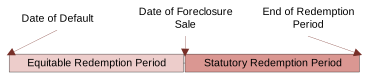
Fast-Track Efforts to Reduce or Eliminate the Redemption Period in Judicial Foreclosure States
To prevent zombies, political efforts in judicial foreclosure states sought to limit the redemption period, or even eliminate it, because homeowners rarely redeem the property, so the property may sit vacant for months or years until the lender finally sells the property. Zombie foreclosures, or zombies, are properties in the process of foreclosure, but which have not been repossessed by the lender. Although homeowners must maintain the property and pay taxes until the sale, they rarely do. Consequently, the properties deteriorate from lack of maintenance, and, when boarded up or showing other signs of being vacant, invites more property destruction from vandalism. Unkempt properties or vandalized properties also lowers the value of the neighborhood.
Source: Shaky Alliances Form to Fight Zombie Foreclosures - MarketWatch
Title Conveyance in a Foreclosure Sale
If the borrower cannot or does not redeem the property, then the deed is conveyed to the highest bidder of the property by the sheriff or master-in-chancery free of liens. However, the deed has no warranties, and conveys whatever title the borrower had.
Homeowners Associations can Foreclose for Delinquent Fees
Homeowners are frequently members of an association of other owners of a particular tract of land, planned development unit, or group of condominiums, with the purpose of enforcing deed restrictions and to maintain common grounds. Property maintenance is outsourced, which reduces costs and lowers maintenance requirements for individual homeowners. To pay for these services, the homeowners association assesses a fee on each homeowner, which can be as much is $400 per month. However, many financially stressed homeowners will stop paying the homeowners fee to conserve cash, requiring the other members of the association to pay more. Consequently, laws were passed in 22 states, the District of Columbia, and Puerto Rico that give the homeowners associations a super lien status, known formally as an assessment priority lien, that gives it a priority lien status even over the primary lender for the property, thus allowing it to foreclose on the property for delinquent fees. Legislation for assessment priority lien statutes is also pending in an additional dozen states. However, the lien cannot be assessed until the delinquency in paying the fees is for a minimum time, such as 6 or 9 months.
Taxes on a Foreclosure
Although a homeowner does not receive any money when a lender forecloses on the home, the IRS still treats it as a sale for tax purposes, and the homeowner must pay a capital gains tax on this so-called phantom income, if the sale price exceeds the homeowner's basis in the property. However, if the homeowner lived at least 2 years in the previous 5 years in the home, then he will be eligible for the home sale exclusion rule that exempts the 1st $250,000 of gains ($500,000 for a joint filers) from taxes, which also applies to the COD income of a foreclosure. A borrower can also avoid paying taxes on the gain if he is insolvent — unable to pay his bills, which generally applies to most people whose homes are foreclosed.
Example: Taxes on a Nonrecourse and Recourse Mortgage
A borrower has a mortgage of $120,000, an adjusted basis in the property of $40,000, and an income that qualifies him for the 5% capital gains rate. Later, the property is foreclosed by the lender. The fair market value of the home is $100,000.
Scenario 1: Nonrecourse Loan
The lender sells the property for $100,000. Because it is a nonrecourse loan, the lender is only entitled to the sale price. The lender has no legal right to get the deficiency of $20,000 from the borrower. But the borrower must pay a capital gains tax of 5% on the $60,000 profit — the difference between the fair market value of the home and the borrower's basis — which equals $3,000, even though the borrower does not receive any of the money.
Scenario 2: Recourse Loan
With a recourse loan, the lender is entitled to the $20,000 deficiency from the borrower, but decides to forgive the debt since the borrower has no assets to pay off the deficiency. Previously, the borrower would have had to pay ordinary income tax on this cancellation of debt income of $20,000 in addition to the capital gains of the foreclosure, even though the borrower does not receive any of the income. With the Mortgage Debt Forgiveness Act, he won't have to pay any tax on the forgiven $20,000 debt, but will still have to pay the capital gains tax on the $60,000 of COD income.
Scenario 3: Insolvency and the Home Sale Exclusion Rule
If the borrower can show that he was insolvent — unable to pay his bills — or that he lived in the home as his principal residence for at least 2 of the previous 5 years, then he will not owe taxes on the capital gain, even in a foreclosure, and whether the loan was a recourse or nonrecourse loan. Note that, without the Mortgage Debt Forgiveness Act, taxes would apply to any forgiven debt, even when the capital gains would be excluded by the Home Sale Exclusion Rule, because COD income is considered ordinary income — not capital gains. However, the borrower could still avoid paying the tax if he can show that he is insolvent.
How Foreclosure Affects Credit Scores
A FICO score can drop by as much as 160 points on a foreclosure. According to https://www.myfico.com/crediteducation/questions/Credit_Problem_Comparison.aspx (no longer available) at MyFICO.com, which is maintained by Fair Isaacs Company, the same company that developed the algorithm for calculating the FICO credit score used by most lenders, the following negative credit events will lower scores by these amounts (format: initial credit score > score range after negative credit event):
- Settling a mortgage for a reduced amount:
- 680 > 615 - 635
- 780 > 655 - 675
- Foreclosure:
- 680 > 575 - 595
- 780 > 620 - 640
- Bankruptcy
- 680 > 530 - 550
- 780 > 540 - 560
Note that higher initial credit scores fall more after a negative credit event. The resulting score depends on other information in your credit report.
Historical Notes
Foreclosure Stripping
- Foreclosure stripping. Many owners of properties being foreclosed, especially in Arizona, Florida, and the Las Vegas area, have stripped their properties of fixtures, such as kitchen cabinets and whirlpools and even carpeting, to sell on Craigslist before the foreclosure. Source: Nice Home. Where's the Rest of It?
- Foreclosure stripping is currently only a criminal offense in Arizona, but is rarely prosecuted due to the difficulty of proving that the previous owner of the property stripped it since many foreclosed properties are abandoned and may have been stripped by non-owners, either to use in their own residence or to sell on Craigslist.
- In other states, such as Nevada, stripping by the owner is not a criminal offense, so only civil remedies are available to the owner of the foreclosed property. Although banks can sue for civil damages, it is usually not worth the cost.
Mortgage Debt Forgiveness Act of 2007
This law allowed that for any renegotiated mortgage or for a foreclosure, any forgiven debt will not be taxable. The law applied to transactions occurring from January 1, 2007 to December 31, 2009. The applicable period was extended several times, until tax year 2017. This law applied only to recourse loans — there is no forgiven debt for nonrecourse loans because the lender must settle for what the property sells for, and cannot go after the borrower for any deficiency.
However, forgiven debt, as cancellation-of-debt income, reduces the homeowner's basis in the property, which will add to any gain by the amount forgiven when the home is sold. The borrower will still have to pay taxes on this capital gain, but it will be at the lower capital gains rate of 5%, 15%, or 20% depending on the borrower's income rather than the usually higher ordinary tax rate on ordinary income that applied to cancelled debt.
Tax forgiveness is limited. No more than $2 million of COD income can be forgiven, and the law applied only to a principal residence — not vacation homes or investment properties. The exclusion also did not apply if the mortgage was refinanced, but the money was not used to improve the property.
Banks Avoided Some Foreclosures
Banks walked away from some foreclosures rather than take possession of low-end properties because high legal fees and repair and maintenance costs often exceeded the property value. Often, when a property sits vacant for awhile, vandals do more damage to the property, thereby lowering its value even more. Many municipalities are making the original owners liable for the property, who usually don't know that their bank had canceled the foreclosure process or simply failed to schedule a sheriff's sale until months afterward. Because the original homeowners already abandoned the properties, and usually don't have the money to maintain the property anyway, some cities have tried to hold the mortgage holders liable, but it is often difficult to find the mortgage holders since the mortgages were securitized and sold to investors. Nonetheless, the city of Buffalo, New York, for instance, sued 37 banks in 2008 to hold them liable for the property's deterioration.
Source: In Homeowners' Latest Woe, Banks Are Skipping Foreclosures - NYTimes.com