Execution, Clearing, and Settlement
Any transfer of financial instruments, such as stocks or bonds, in the primary or secondary markets involves 3 processes:
- execution
- clearing
- settlement
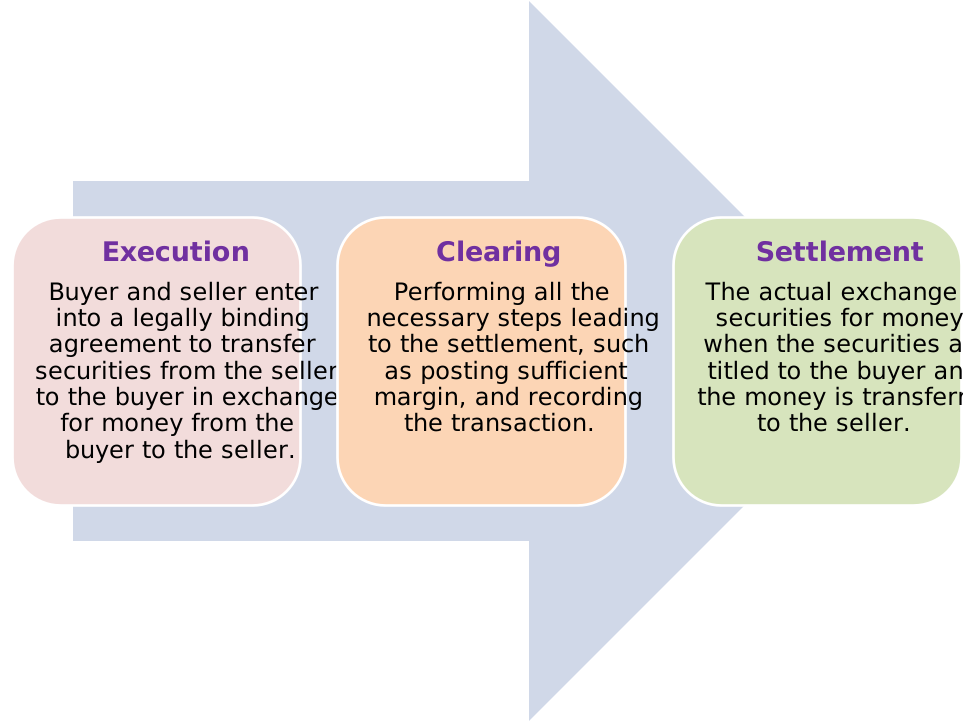
Execution is the transaction whereby the seller agrees to sell and the buyer agrees to buy a security in a legally enforceable transaction. All processes leading to settlement is called clearing, such as recording the transaction. Settlement is the actual exchange of money, or some other value, for the securities.
Clearing is the process of updating the accounts of the trading parties and arranging for the transfer of money and securities. There are 2 types of clearing: bilateral clearing and central clearing. In bilateral clearing, the parties to the transaction undergo the steps legally necessary to settle the transaction. Central clearing uses a third-party — usually a clearinghouse — to clear trades. Clearinghouses are used by the members who own a stake in the clearinghouse. Members are often broker-dealers. Only members may directly use the services of the clearinghouse; retail customers and other brokerages gain access by having accounts with member firms. The member firms have financial responsibility to the clearinghouse for the transactions cleared. It is the responsibility of the member firms to ensure that the securities are available for transfer and that sufficient margin is posted or payments are made by the customers of the firms; otherwise, the member firms must cover any shortfalls. If a member firm becomes financially insolvent, only then will the clearinghouse make up for any shortcomings in the transaction.
For transferable securities, the clearinghouse aggregates the trades from each of its members and nets out the transactions for the trading day. At the end of the trading day, only net payments and securities are exchanged between the members of the clearinghouse. For options and futures and other types of cleared derivatives, the clearinghouse acts as a counterparty to both the buyer and the seller, so that transactions can be guaranteed, thereby virtually eliminating counterparty risk. Additionally, the clearinghouse records all transactions by its members, providing useful statistics and allowing regulatory oversight of the transactions.
Settlement is the actual exchange of money and securities between the parties of a trade on the settlement date after agreeing earlier on the trade. Most settlement of securities trading nowadays is done electronically. Stock trades are settled in 1 business day (T+1), including government bonds and options. The T in T+1 signifies the trade or transaction date.
Important note! A business day means a banking business day. A few days per year, stock markets are open but banks are closed. For instance, in the United States, the stock market is open on Columbus Day and Veterans Day, but the banks are closed, so a trade that occurred 1 business day before these holidays will not settle until the day after the holiday.
Forex transactions involving currencies from North American countries have a T+1 settlement date, while trades involving currencies outside of North America have a T+2 settlement date.
In futures, settlement refers to the mark-to-market of accounts using the final closing price for the day. A futures settlement may result in a margin call if funds are insufficient to cover the new closing price.
As of May 28, 2024, the settlement time for most securities in the United states is a single business day, T+1 settlement.
Modern day settlement and clearing evolved to solve the mushrooming paper crisis created by recording the many more security trades of stock and bond certificates being traded in the 1960's and 1970's, while payments were still made with paper checks. Brokers and dealers either had to use messengers or the mail to send certificates and checks to settle the trades, which posed a huge risk and incurred high transaction costs. At this time, the exchanges closed on Wednesday and took 5 business days to settle trades so that the paperwork could get done. As more of the trading network became computerized, settlement times have decreased. The T+3 settlement time, which began after the Black Monday crash of 1987 and remained prevalent before 2018 was shortened by the SEC in 2017 to T+2 (Source: SEC.gov | SEC Adopts T+2 Settlement Cycle for Securities Transactions), then shortened again to T+1 settlement in 2024.
T+1 settlement was actually prevalent in the 1920s and before, when brokers or their agents would actually meet to exchange cash and securities, but toward the end of the 1920s, trading volume increased too much to be handled manually, so settlement time was eventually increased to 5 days. Though trading volume is much greater today, computers have the speed and capacity to handle the billions of transactions occurring daily.
Most countries of the world still have T+2 settlement, but some countries have or will be reducing their settlement times.
- India already has T+1 settlement, and even same-day settlement in 25 stocks.
- Canada and Mexico have moved to T+1 on May 27, 2024.
- Settlement times for China’s markets range from same day to T+2.
- The UK plans to move to T+1 no later than the end of 2027.
- Europe and Australia are still using T+2 settlement with no firm plans yet to move to T+1.
The 1st solution to this problem was to hold the certificates at a central depository — sometimes called certificate immobilization — and record change of ownership with a book-entry accounting system that was eventually done electronically. The New York Stock Exchange was the 1st to use this method through its Central Certificate Service, which eventually become the Depository Trust Company, then became a subsidiary of the Depository Trust and Clearing Corporation (DTCC). In Europe, Euroclear and Clearstream are the major central depositories. The process of eliminating paper certificates entirely is sometimes called dematerialization.
A further improvement was multilateral netting, which further reduced the number of transactions. Brokers have accounts at central depositories, such as the DTCC, which acts as a counterparty to every trade. So instead of sending payments and securities for each transaction, trades and payments were simply aggregated during the day for each member broker, then were settled at the end of the day by transferring the net difference in securities and funds from 1 account at the depository to another.
Example: if a broker bought 100 shares of Microsoft for a customer and sold 50 shares of Microsoft for another customer, then the broker's net position is the accumulation of 50 shares of Microsoft, which would be recorded at the end of the market day. If the broker paid $25 per share to buy the 100 shares of Microsoft stock and sold the 50 shares for the same price on the same day, then the net difference + transaction costs is debited from the broker's account at the end of the market day, and credited to the account of the central depository. Likewise, only 50 shares of Microsoft would be transferred to the broker's account since this is the net difference of buying 100 shares and selling 50 shares.
How Does T+1 Settlement Apply to 24-Hour Trading?
Many brokerages now offer 24-hour trading, 5 days a week (24/5 trading), from Sunday 8:00 PM to Friday 8:00 PM. I could not find official legal or regulatory information regarding settlement times for overnight trades that would apply to all brokerages, but Charles Schwab and Robinhood set the trade date for any trades executed between 8:00 PM and 12:00 AM for the next business day. So, a trade executed on Sunday will have the trade date as Monday. Per Charles Schwab, the settlement time is 8:00 PM Eastern time on the trade date. So, a trade executed on Sunday with Charles Schwab’s thinkorswim platform will be treated as having a trade date on Monday that settles at 8:00 PM ET on Monday since Monday 8PM is considered the start of the Tuesday trade date. Likewise, a trade at 7:30 PM on Monday will settle 1/2 hour later, at 8 PM.
The Role of Clearinghouses in Trades
Because it takes time to settle a trade and to protect the financial integrity of the clearinghouses, clearinghouses require collateral from member firms. Member firms must post collateral depending on
- the number of trades they are executing
- the volatility and risk of the securities being traded
- the imbalance between buying and selling, and
- the firm’s financial condition
Because trading volume and risk changes every day, firms must adjust their collateral at the clearinghouse daily. Clearinghouses even provide tools to their member firms so that they can anticipate the daily changes of collateral requirements. But, sometimes, a trading frenzy of volatile securities can quickly drive up collateral requirements. For instance, in early 2021 Robinhood Securities, which uses the DTCC as its clearing firm, was required to post more than 10 times their normal collateral because their customers were trading GameStop and other meme stocks in a frenzy, quickly driving up stock prices well beyond their value as measured by traditional means. The DTCC feared that Robinhood’s customers would be unable to meet their margin requirements, which may have made it difficult for Robinhood to meet its own margin requirements with the DTCC. Robinhood responded by temporarily curtailing the trading of volatile securities, especially GameStop, to limit their risk and to lower the additional collateral they had to post with the DTCC. Even so, Robinhood was forced to get additional funding from its investors to cover the greatly increased collateral requirements.
Brokers must post collateral with the clearinghouses because there is financial risk between the time the securities are purchased to when they are settled. With so many financial transactions nowadays being electronic, many people have wondered why the settlement time must be so long. Why not settle the trade as part of the trade? Australia has tried to cut down the settlement time from days to minutes on the Australian Stock Exchange since 2016, but as of March 2021, it is still reportedly 2 years behind schedule. Some companies are also trying to use the blockchain to settle trades more quickly, but none are in widespread use as of 2021. A major reason for the delay is that many banks, brokerages, hedge funds, and other financial institutions must update their systems to handle instant settlement.
Nowadays, governments around the world are promoting, or even requiring, central clearing, so that they can assess the systemic risk being imposed upon economies by their financial institutions, especially in the trading of derivatives, as was witnessed in the recent Great Recession of 2007 - 2009, when governments had to bail out many financial institutions to prevent a possible domino effect of major institutional failures. Central clearing is the best way to maintain records, to better monitor the financial risks to the economy.
Is T+0 Settlement Coming Soon? How about Instant Settlement?
Problems shortening the settlement time occur because different institutions use separate methods to record transactions, and those transactions must comply with the laws in their jurisdiction.
Most of the money in the world is recorded in separate databases in separate institutions spread across the globe. When money is transferred from 1 institution to another, the databases at each of those institutions must be updated, which means that the account of the payer in the sending institution must be debited by the amount transferred, and the receiving institution must update a record within their database by crediting the account of the recipient of the money. So the interaction depends on the coordination of the 2 separate systems used by the institutions and the transaction must comply with the laws of the respective countries of those institutions.
So institutions involved in trades must update their systems in such a way that their systems can securely and accurately transact with other systems. Shorter settlement times also mean there would be less time to correct mistakes or to prevent fraud.
Blockchains boast about instant settlement, but they can do this because their systems were based on a new system, which did not have to account for legacy systems and, so far, they need not follow extensive legal requirements.
The reason why blockchain transactions can be settled instantly is because each blockchain for any cryptocurrency records all the transactions in that cryptocurrency. A blockchain is just a database that operates in a particular fashion. Though there may be many copies of the blockchain, such as for Bitcoin or Ethereum, all copies record the same transactions, so they can be quickly updated. Blockchains are also designed so that the information cannot be altered easily, which increases the security of the transactions. This is a major advantage for blockchains, and this is the reason why some major banks are experimenting with blockchains.
The major problem with using a blockchain on a global scale for financial institutions is that there must be an agreement on how the blockchain would function and who would operate the blockchain, especially to make it scalable so that recording transactions is inexpensive and quick. Countries would also have to update their laws to even allow a blockchain to be the ultimate record of financial transactions within that country, which is not likely to happen anytime soon.
Execution, Clearing, and Settlement in the News
- Paxos Trust Company, a blockchain startup serving financial institutions, is settling stock trades within hours rather than the days the DTCC usually requires. The Paxos system uses the Ethereum blockchain to connect investors directly with each other instead of using an intermediary like the DTCC. Risks are reduced by requiring margin from the traders. Settlement risk is reduced by using swaps to exchange tokenized versions of money and shares. (Note that tokenization still requires an intermediary since there must be some way to ensure that the tokens have a legally verified value, that the tokens actually represent a beneficial interest in the underlying asset. Paxos, for instance, is a trust company and a custodian of its tokenized assets, regulated by the New York State Department of Financial Services. However, transactions can proceed without an intermediary if the system is constructed properly.) Paxos plans to file a full clearing-agency registration with the SEC by early June 2021. (4/6/21: Stock Trades Settled in Hours, Not Days, as Blockchain Model Grows)