About William C. Spaulding and thismatter.com
My name is William C. Spaulding, the author of all the articles on https://thismatter.com. I also have an author website at https://author.thismatter.com. The privacy policy for this site is at https://thismatter.com/privacy.htm.
The purpose of this website is to provide fundamental information about economics, personal finance, and investments, and to present the information as concisely and as clearly as possible — through examples, illustrations, tables, and other pedagogic aids — for the fastest comprehension. It is not intended as financial, trading, or legal advice, but rather, to provide an overview of how things work and, sometimes, why things work as they do.
My articles have many links to other articles on my site and to external resources. Links to other articles on my site, such as this one on credit scores, are underlined in blue, or red if visited, and open in the same window. Links to external references are underlined in green as in this https://example.com and open in a new window. If they are PDF files, then the link will be underlined in black and will display "PDF" when you hover over it, as you can do right now for this example link: https://www.example.com/example.pdf.
A table of contents in outline form is at the bottom of every page. Clicking a link in the 1st column of the table displays the headings and some of the links in the 2nd column for that subject. Headings can be expanded or contracted by clicking or touching the heading.
My website also has style sheet sections for printing and for viewing on mobile devices. If a page is printed, it will not include any advertising, navigational links, or any other content that would not be useful on the printed page. On screens wider than 1,400 pixels, there is a fixed sidebar with a search box at the top followed by navigational links to major sections of the site. In the footer of each page are sharing tools, such as for Facebook, Google+, or Twitter. On smaller screens, the pages have no sidebar so that all the screen space can be devoted to the article. In this case, the search box is located below the footer near the bottom of each page.
To facilitate navigation, my website provides these keyboard shortcuts:
- Control + /: Scroll to full site menu
- Alt + ` (backtick): Sets focus in the Google search box to search this site.
- Alt + 0: Show detailed article outline
- Alt + .: Show only headings in the outline
- Alt + 1: Show article links
- Control + Right Arrow: Next Article
- Control + Left Arrow: Previous Article
I originally added the outline feature to facilitate article editing, but it is also a good way to navigate within the document, especially a long document. You can click any element in the outline to go to that element in the document. The outline will close when any part of the outline is clicked. With the full site menu, you can quickly see all the articles on my site by clicking the various headings and subheadings. Clicking on a link will take you immediately to that article.
Update Policy
I try to keep my website updated about important facts or how things work. However, some things do not need to be updated if they continue to provide pedagogical value. For instance, I have written several articles on option strategies that are several years old. Creating these diagrams from actual market prices takes time and effort, but there is no pedagogical value in updating the prices to reflect current times. The main point of these illustrations is to show how option spreads work.
However, I do try to update changes in law or how things work or other matters that could benefit from an update. Note, however, that I cannot guarantee that all the information on my website is up to date.
As always, when researching information for any important financial decision, always perform due diligence, consulting several sources, especially primary sources, such as IRS.gov for tax information. The sole purpose of my website is to provide education and tips, nothing more.
My Credentials
I am a financial writer who has been writing about financial topics since 2005. I have a degree in philosophy and business from Millersville University, located in Lancaster County, Pennsylvania, but most of my knowledge comes from constantly reading, writing, thinking, and doing examples. I continually read textbooks, magazine articles, and other news sources about economics, personal finance, and investments. Unlike most other sites, I continually edit my articles to provide more updated and clearer information, especially when my readers alert me to mistakes or ambiguities. I also provide worked-out examples for many of the articles. Writing is the best education because it forces you to think deeply about the topic, to research it thoroughly, and to ensure that it coheres with other principles and facts. I sometimes disagree with the consensus, and I will point out why I believe it is so, allowing you to decide if my argument has merit. I also get feedback from readers like yourself, pointing out mistakes I correct immediately — a major benefit of reading from a website rather than a book, even an ebook.
I also provide many references to my topics, including individual facts, such as points of law, where you can review that information instantly by clicking on the link, which will open a new window. For instance, in my tax articles, I provide direct links to all the referenced IRS forms, as well as many individual provisions of the tax code and to the many instructions and other publications by the IRS.
Of course, another source of my knowledge, is from personal experience, though it is, by necessity, much more limited than the many topics that I cover. Nonetheless, writing about many topics gives me a greater perspective and better insight into each topic since they are interrelated.
My Books

How to Invest in Bonds for Maximum Profit shows how you can invest in bonds to maximize your profits, especially when interest rates are high, as they are now.
Imagine if you could pick only stocks that would rise the most. Well, as far as I know, there is no sure way to do that with stocks, but there is a way to do that with bonds. This book will show you how, and it will show real examples of how this works and how much you can potentially profit, and how bonds, at times, can even be better than stocks. This book will also show the best way to combine investments in bonds with investments in stocks.
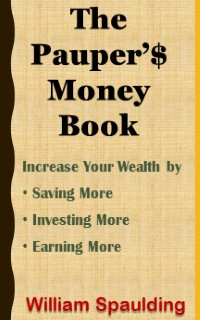
The Pauper's Money Book shows how anyone can manage their money to greatly increase their standard of living.
- Save, Invest, and Earn More Money
- Increase Your Credit Score
- Learn to Negotiate Successfully
- Manage Time Effectively
- Invest for Maximum Results with a Minimum of Risk
- Minimize Taxes, Earn Tax-Free Income
- Earn More from a Career or from Running a Business
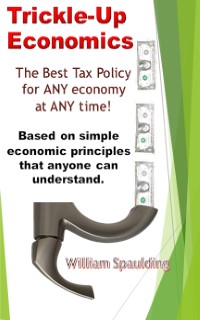
Trickle-Up Economics describes the best tax policy for any economy, based on 3 simple economic principles that anyone can understand. This book not only describes the best tax policy, but it also explains why the current tax policy is both inadequate for generating sufficient revenue for the government, and how it increases inequality. So, if you want to argue intelligently about tax policy at your next party or family gathering, this is the book to get. :-)
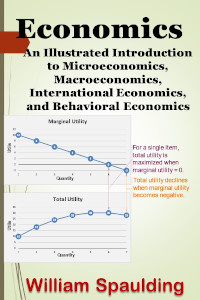
An introductory textbook on Economics, lavishly illustrated with full-color illustrations and diagrams, and concisely written for fastest comprehension. This book is composed of all the articles on economics on this website. The advantage of the book over using the website is that there are no advertisements, and you can copy the book to all your devices. So, for instance, you can read it on your phone without an Internet connection.
Advertising
Currently, the only advertising that I display are Google ads. I am not interested in affiliate marketing or any other type of advertising at the present time. The Google AdSense program takes only minimal effort to set up and requires little maintenance, letting me to focus on writing.
I don't do link exchanges. I only link to articles that I think are worthy of the link or that were sources of information for an article. And when I do provide a link, I never ask for one in return since I expect that other people should only link to my site if they think it is worthy and relevant.
I also never allow anyone else to write articles for my site, especially when the purpose is to provide links to their site. So don't ask.
Another request that I often receive is to review somebody's website. I have a schedule of my priorities, and only so much time to do it. Furthermore, I currently do not write reviews of other websites. I do sometimes mention websites, and provide links to them, if I think it is a good site, but I will not disrupt my schedule simply to respond to someone's request.
A Note to the Grammarian Police
Originally, grammar was the study of how a language was constructed, how the individual words are put together to form meaning. Then, in time, some people dubbed themselves to be the grammarian police — grammandos! — and have asserted that writing must follow the grammar rules rigorously, and, nowadays, we even have grammar software to ensure that our writing is so constructed. I disagree with maintaining a rigid grammatical structure.
The main purpose of language is to communicate. If there is a better way to communicate, it should be done, even if it breaks the grammar rules. Case in point: writing numbers as actual numbers rather than as words because numbers can be read faster when they are written as numbers rather than as words, including the numbers 1 through 10. (The only problem with 1 is that it looks like I, depending on the font family of the letters, and my voice recognition software seems to prefer "one" over 1.) However, I only use the number 1 when referring to the number, not when it is being used to refer to a person or thing, such as "any one of you". I also know that grammandos are not gonna like "gonna" nor the fact that I put the period after the apostrophe. (Okay, I only used "gonna" here to make the grammandos cringe a little.) I also often write first as 1st and second as 2nd, and so on. I don't always write ordinal numbers this way since I must consider how people will search for certain topics. So in those cases where the ordinal number may be part of popular search terms, I will continue to write it out as a word.
Because nouns can also be used as adjectives, I have also chosen, in many cases, where there is no possibility of misinterpretation, to use the noun as an adjective rather than using possessive forms of the noun. So, I write stockholders equity rather than stockholders' equity. This looks cleaner. I also put punctuation marks after quotation marks instead of before the end quotation mark. I think it looks better, and I sometimes do not want the punctuation marks to be within the quotation marks, such as quoting search terms. For instance, to get basic information about companies from general search engines, I may write to just search for the term stock + the ticker symbol, such as “stock MSFT”. This also makes it easier to select the search terms without selecting the punctuation mark, and the punctuation mark itself also stands out.
I think language can be improved in many ways to speed comprehension. For instance, using mathematical symbols for some words, such as = for equals. I don't always do this on my site because I am not sure how people would react. But I believe that people would comprehend written documents faster if they were so written. It might be worthwhile to have some scientists measure the differences in comprehension speed between a document that used all words and a document that used other common symbols, especially mathematical symbols.
In fact, a committee should be formed to seek ways to improve language in much the same way as the W3.org works to improve HTML and CSS.
I would like to make 1 suggestion right now. In English, no word refers to either male or female in the 3rd person singular. Hence, writers are reduced to saying he or she, his or her, or him or her, or they are forced to alternate between the references to avoid being labeled sexist. Sometimes this is useful when using 2 people in examples since this removes any ambiguity in pronoun referents, but usually it results in superfluous language. Therefore, I propose this: e to refer to the 3rd person singular for either sex and er to refer to the objective case, as her does for the pronoun she, and ers for the possessive case. Maybe this new 3rd person singular should be capitalized as the pronoun I is, to distinguish it from the natural logarithm base e, although, usually, context should clarify the meaning. In any case, this is just a suggestion. I will also likely use singular they more, if the meaning is clear.
English also needs a 2nd person plural pronoun that differs from the singular pronoun. Though context often distinguishes between them, too many times, the referent is ambiguous. A natural suggestion would be "yous."
I have also decided to cut back on my use of the words generally and usually, and other, often superfluous, words. Although I use these terms a lot because most statements have exceptions, not modifying the statements with generally or usually doesn't mean that the statement is categorical. But removing these terms often makes the reading better, I think. I will only use these words when necessary. I have only started this on November 23, 2019, so most of my articles still use these terms liberally.
This is not to say that this site has no unintended grammatical errors that impede comprehension. Although I run the documents through a grammar checker for a 2nd opinion, even if I don't always follow that opinion, I am sure that errors slip through anyway. Nonetheless, if you want to comment on this, please email me. I would be interested in your opinion. Maybe I should set up a Facebook page for this topic, but, alas, I do not have the time.
Since there are over 800 articles on this site written since 2005, my thoughts on grammar and my propensities have changed through the years, yielding some inconsistencies in the rules that I have used, something that grammandos the world over are definitely not gonna like, but since what is acceptable and not acceptable in grammar has changed throughout the years as evinced by the changing results of Usage Panel surveys and by literature itself, my main objectives are clarity and conciseness. You can at least be consoled that there is no Beowulf here.
Feedback
At the bottom of every page, including this one, I provide an email link so that if you want to respond to any page or to comment on it, you can do so by emailing me. As I have said, I always appreciate constructive feedback. The email address is a forwarding address that will forward all email to my true email address. I did this so that I can readily change the email address on the webpages if I start getting spam.
Remember: The purpose of this website is to give a fundamental overview of the topics covered, so do not rely on this website for advice on specific matters. Readers frequently email me, asking specific questions. I will gladly respond to errors or ambiguities in the articles. However, I do not have the time or expertise to answer specific questions about your particular situation, so please do not ask.
Sometimes people email me with many questions or ask me something requiring a lengthy response for a proper answer. I believe that many of these people are students. Usually, I will not respond to these types of questions, because I don't have the time and because it isn't my duty to do their homework.
I am also not on social networks, because I do not have the time for general chitchat. Since I already do much writing for my website, it is much more tiring to also write extensively on social networks. The only reason why I am on Google+ is to establish my authorship link since I must worry about my ranking authority to increase traffic. However, I do not update my Google+ profile that much. I do believe that the authorship attribute is a great idea since it presents a great impetus to write the best articles, but I would rather do all my writing on my own site, where I have complete control and where I can benefit the most from my writing.
I hope you enjoy my site. If you have any constructive comments or suggestions, please email them to me.