Supply Elasticity
Suppliers profit by selling goods and services at higher prices than their cost to produce. The amount of profit is determined by the cost of the factors of production to produce the product and on the suppliers' efficiency in producing the product. Since higher prices facilitate earning a profit, and since the amount of profit also depends on the quantity sold, if increased demand raises prices, then suppliers will respond by increasing their supply to earn a higher profit. Of course, this is merely the law of supply, but it does not state how much supply will change when prices change. The elasticity of supply measures the percentage change in the quantity of supply compared to the percentage change in a supply determinant, much like how the elasticity of demand is measured. Although the elasticity of supply can be measured against several supply determinants, the most important is the price. The price elasticity of supply measures the percentage change in supply quantity compared to the percentage change in the price, which, in turn, determines the change in total revenue.
| Supply | Quantity Change % | |
| Price | = | ÷ |
| Elasticity | Price Change % |
The price elasticity of supply varies widely, depending not only on the product or service, but also on whether the price change occurs over a short time or a long time. If the supply changes little with a change in price, then supplies are considered inelastic. Supply is elastic if there are large changes in supply for a small change in price. If the percentage change in price is equal, though opposite, to the percentage change in quantity, then supply elasticity is unit elastic.
For instance, the supply of land is generally inelastic, because, as Will Rogers once quipped, they're not making any more of the stuff. By contrast, the supply of software is almost perfectly elastic since it costs little to make and distribute copies of software.
Graphs of Perfectly Elastic and Perfectly Inelastic Supply
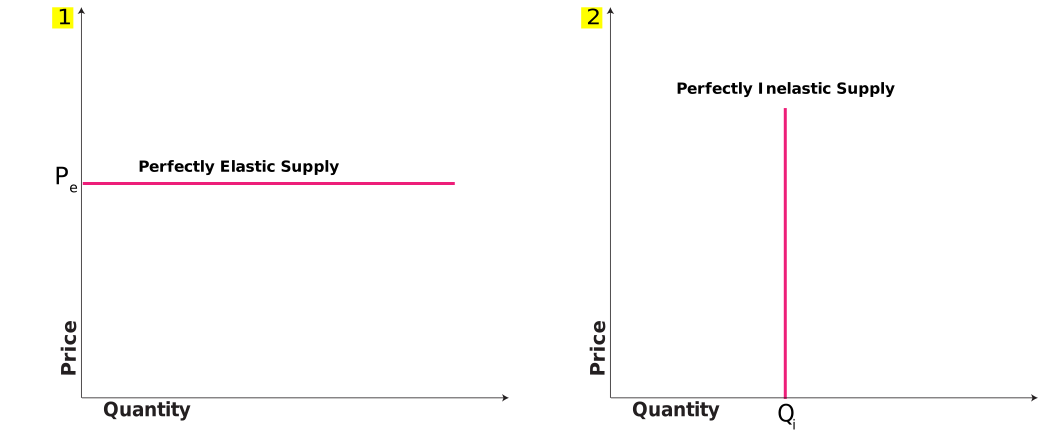
Perfectly Elastic Supply (Graph #1):
- Elasticity = ∞.
- Suppliers will supply any amount above price Pe.
- At Pe, the market supply equals the quantity demanded.
- No supplier wants to supply its product for less than Pe.
- A perfectly elastic supply can be best illustrated by a drug company selling a cancer drug that cures cancer. The drug company will sell it at the highest price that the market will bear, but it will supply any amount at that price. Higher prices would make the drug unaffordable.
Perfectly Inelastic Supply (Graph #2):
- Elasticity = 0
- At quantity Qi, the supply amount does not change with market demand, whatever that is, regardless of the price.
- The best real-world example of perfectly inelastic supply is land, since suppliers can only sell what they have — they cannot create more, regardless of the price, although a higher price would induce more landowners to sell.
| If supply elasticity | < 1 | then supply is | inelastic |
| = 1 | unit elastic | ||
| > 1 | elastic |
The price elasticity of supply varies over the supply curve for most goods or services, because production often involves several different methods of increasing the supply. For instance, when the price increases, suppliers can increase the use of their available resources and they can hire more labor over the short term. Suppliers may also be able to shift resources from less profitable to more profitable products. However, if the price continues to rise, then suppliers must make major investments to continue increasing the supply, so the price elasticity of supply is elastic at first, when suppliers can put idled resources to work, then becomes more inelastic over the short term as prices continue to rise, not only because suppliers must make major investments, but it would take time for new suppliers to enter the market. Likewise, if prices fall, suppliers can idle resources and lay off their workers, but suppliers tend to maintain a minimum supply to cover fixed costs. However, as prices continue to drop, then eventually suppliers will sell their factors of production, or suppliers will leave the industry to find better opportunities elsewhere.
For example, if a farmer brings a truckload of watermelons to the farmers market, then he will try to sell all the watermelons, regardless of the price; otherwise, the watermelons will perish. On the other hand, even if the price is very high, the farmer has no way of supplying more watermelons right away.
Over the short run, supply tends to be in inelastic, because of the limited options available to change supply. Over the long-run, supply becomes more elastic, because suppliers can take actions that take more time to increase the supply, such as building new factories, or growing more of a certain crop on farmland.
How Prices Change With Demand Under Inelastic and Elastic Supply
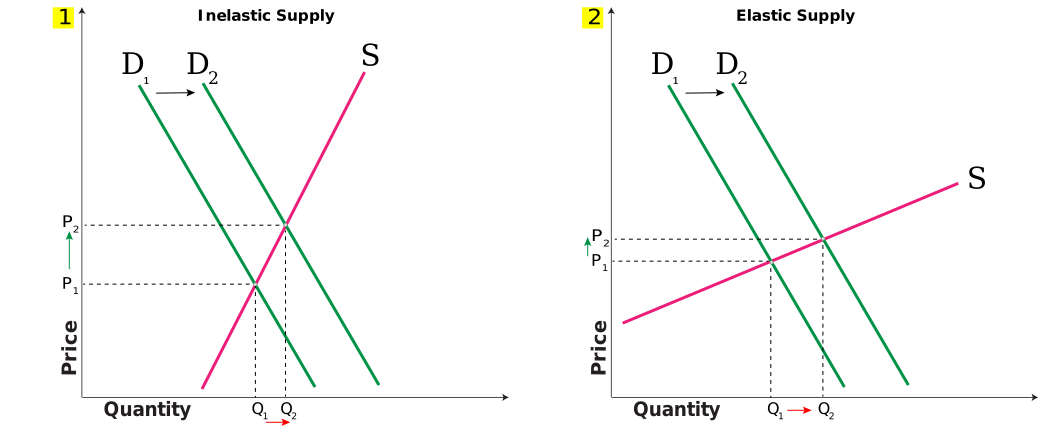
Inelastic Supply (Graph #1):
- When demand changes from D1 to D2, the percentage change in price exceeds the percentage change in quantity provided.
Elastic Supply (Graph #2):
- When supply is elastic, then the percentage change in quantity exceeds the percentage change in price.
Supply Inelasticity Makes Bitcoin Unusable As Money
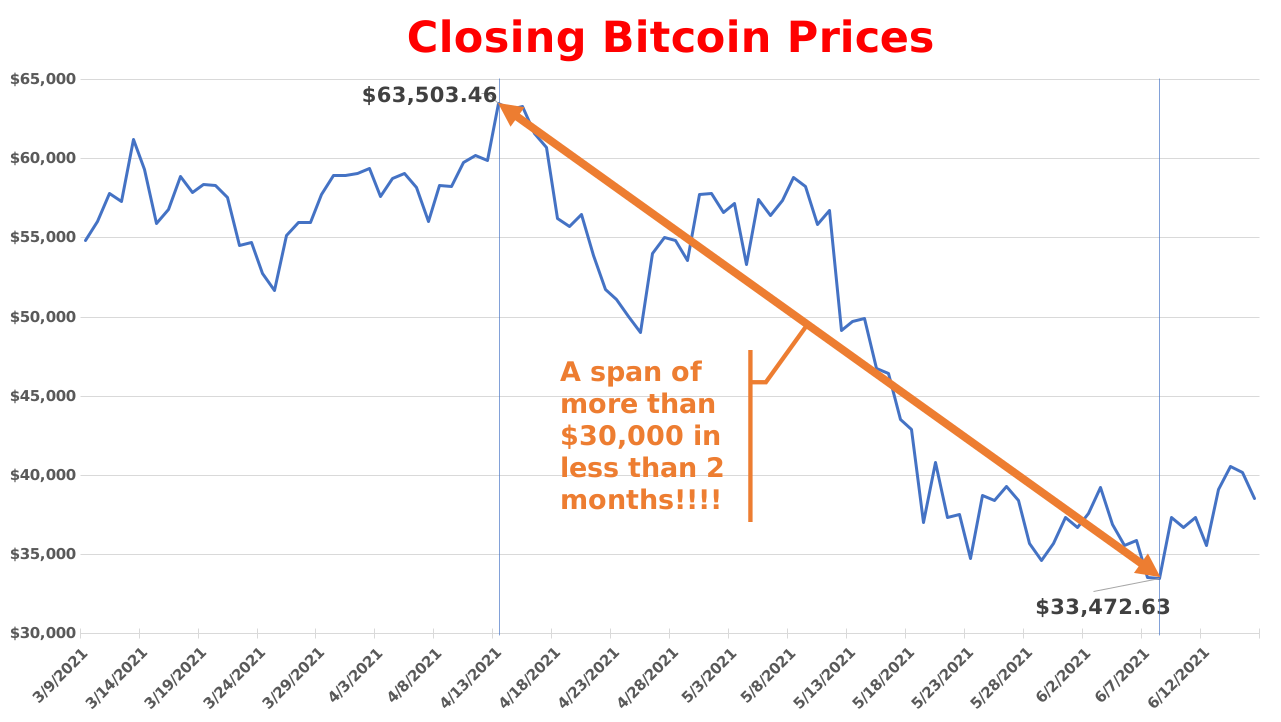
Bitcoin is a great example of an inelastic supply. There are many problems using Bitcoin as money. Some of these problems can be mitigated with better technology and procedures, but one problem cannot be solved that makes Bitcoin very undesirable as money: volatility.
A primary problem Bitcoin was trying to solve was to develop a trustworthy financial system that did not rely on a third party, such as the government. But without a third-party, how do you control the supply of money? Bitcoin solved this problem by fixing the supply to a maximum of about 21 million Bitcoins. These Bitcoins are created by a mining procedure of solving cryptographic puzzles that yields fewer and fewer Bitcoins per unit of time.
It is estimated that all 21 million Bitcoins will have been created by the year 2140. In 2021, there were almost 19 million Bitcoins, which means that only slightly more than 2 million Bitcoins will be mined in the next 119 years. This means that, for all practical purposes, the supply of Bitcoin is fixed. The supply of Bitcoin is almost perfectly inelastic. Indeed, the supply of Bitcoin is perfectly inelastic since changes in demand has no effect on the supply quantity, even though Bitcoin mining is slowly creating new Bitcoins. (Whether the supply of Bitcoins is increasing or decreasing is difficult to ascertain, since many Bitcoins are lost because they were sent to the wrong address or because the owners lost their crypto keys. The number of Bitcoins lost may exceed the number being created, in which case, the supply may decline.) Thus, supply inelasticity can be more accurately defined as a supply that does not change in response to demand, even if the supply does change for other reasons. Bitcoin is a perfect example of this. Its supply is slowly changing through mining, but it is not in response to demand. Thus, the supply of Bitcoin is perfectly inelastic.
An inelastic supply means that changes in demand will only change the price of Bitcoin, and since only the price changes and not the supply, the price changes will be significant.
How Prices Change With Demand Under a Perfectly Inelastic and a Perfectly Elastic Supply
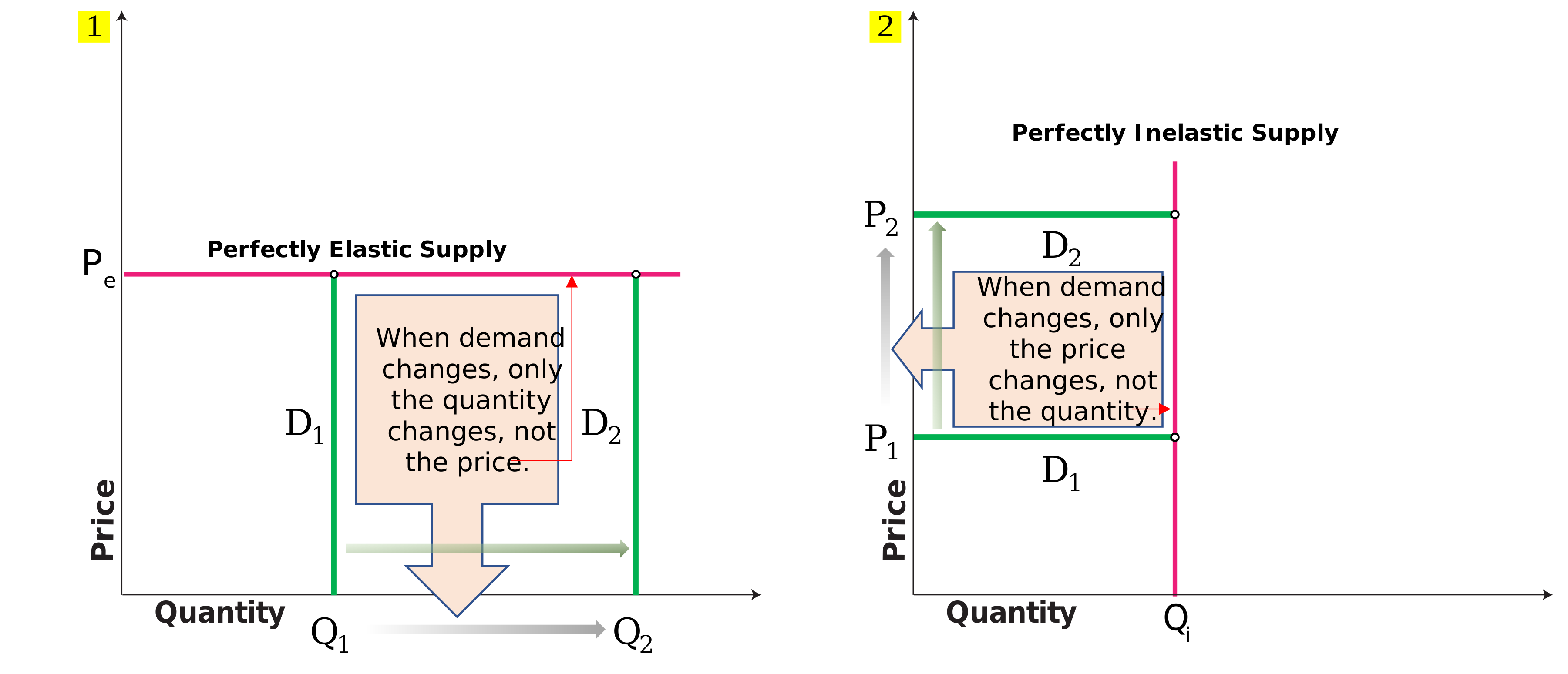
Perfectly Elastic Supply (Graph #1):
- When demand changes from D1 to D2, only the quantity changes, not the price.
Perfectly Inelastic Supply (Graph #2):
- When the supply is perfectly inelastic, only the price changes with demand, not the quantity. This is why Bitcoin is so volatile.
Money has 3 primary functions: to serve as a unit of exchange, a unit of account, and as a store of value. However, these characteristics require that the underlying unit of money be stable in value. After all, how do you measure the price of something, when the price of the money itself is changing constantly? Consider just some of the problems:
- Businesses would not be able to do their accounting, since the real value of prices and costs listed in Bitcoin would change constantly.
- Buying something would require looking up the value of Bitcoin before the exchange to know how much to exchange.
- Holding Bitcoin as a store of value would be extremely risky, as has been shown many times in the past.
- People and organizations would experience constant financial uncertainty, since the true value of what they earn or receive in Bitcoin can only be known after it has all been spent. In other words, the goods and services that Bitcoin can buy cannot be known until it is spent.
Because the demand for money varies with the economy and with the population, the only way to keep the value of money stable is by varying the supply to meet demand. This is one reason why most countries are no longer on the gold standard and why they use central banks to control the money supply. Central banks are in the best position to monitor the demand for money and to control the supply, since they are the creators of money. Most central banks are also granted some political independence so that the money supply is not manipulated according to the whims of politicians.
That central banks work is attested by the low, predictable inflation of major economies. This low, steady inflation allows people, businesses, and governments to plan their future, which would be extremely difficult with a currency that varies in value.
Because it takes time for the population to determine whether there is too much or too little money in the economy, the supply of money is almost perfectly elastic in the short term, but not in the long-term. This gives central banks some wiggle room to stimulate or throttle the economy as needed to optimize economic output without changing the perceived value of the currency.