Bond Formulas
This page lists the formulas used in calculations involving money, credit, and bonds. If you want to learn about these topics in detail, read the referring page.
Present Values and Future Values of Money
From The Present Value and Future Value of Money.
| FV | = | P(1 + r)n |
| ||
| PV | = | FV (1 + r)n |
| ||
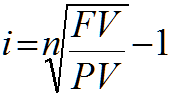
| i | = | ( | FV PV | ) | 1/n | - 1 |
| i = Interest Rate of Discount per time period n = number of time periods FV = Future Value PV = Present Value | ||||||
or
From The Present Value and Future Value of an Annuity.
| FVOA | = | A | × | (1 + r)n - 1 r |
| FVAD | = | A | × | (1 + r)n - 1 r | + | A(1+r)n | - | A |
| PVA | = | n ∑ k=1 | A (1+i)k |
| PVA = Present Value of Annuity Amount A = annuity payment i = interest rate per time period n = number of time periods | |||
| PVA | = | A * | 1- | 1 (1 + i)n |
i | ||||
| A | = | PV 1-(1+i)-n i | = | PV * | i 1-(1+i)-n |
| Formula for the monthly payment of a loan. A = monthly payment, or annuity payment. PV = present value, or the amount of the loan. i = interest rate per time period. n = number of time periods. | |||||
Bond Yields
From Bond Yields.
| Nominal Yield | = | Annual Interest Payment Par Value |
| Current Yield | = | Annual Interest Payment Current Market Price of Bond |
| Taxable Equivalent Yield | = | Muni Yield 100% - Your Federal Tax Bracket % |
| Approximate Yield-to-Maturity % | = | Annual Interest + (Par Value - Bond Price)/Years till Maturity (Par Value + Bond Price)/2 |
A more accurate calculation of yield to maturity or yield to call or yield to put:
| Bond Price | = | C1 (1+Y)1 | + | C2 (1+Y)2 | + ... + | Cn (1+Y)n | + | P (1+Y)n |
| ||||||||
or, expressed in summation, or sigma, notation:
| B | = | n ∑ k=1 | Ik (1+Y)k | + | P (1+Y)n |
| i = | (Future Value/Present Value)1/n - 1 | |
| i = interest rate per compounding period n = number of compounding periods FV = Future Value PV = Present Value | ||
or
| Interest Rate Per Term | Number of Terms per Year | ||
| BEY = | Face Value - Price Paid Price Paid | × | Actual Number of Days in Year Days Till Maturity |
From Bond Pricing, Illustrated with Examples
| Accrued Interest | = | Interest Payment | × | Number of Days Since Last Payment Number of days between payments |
From Volatility Of Bond Prices In The Secondary Market; Duration and Convexity
| T ∑ t=1 | t × Ct (1 + y)t | |
| D = | ||
| T ∑ t=1 | Ct (1 + y)t | |
| ||
| Note that the denominator = the sum of all cash flows discounted by the yield to maturity, which = the bond's price. | ||
Duration and Convexity
From Duration and Convexity, with Illustrations and Formulas
Bond Value = Present Value of Coupon Payments + Present Value of Par Value
| Duration | = | P- − P+ 2 × P0(Δy) |
| P0 = Bond price. P- = Bond price when interest rate is incremented. P+ = Bond price when interest rate is decremented. Δy = change in interest rate in decimal form. | ||
| Macaulay Duration | = | T ∑ t=1 | t | × | wt |
| |||||
Where:
| wt = | CFt / (1 + y)t Bond Price | = | Present Value of Cash Flow Bond Price |
| |||
| Modified Duration | = | DMac 1 + y/k |
| ||
| Effective Duration | = | − | ΔP/P Δi |
| |||
The formula for the duration of a coupon bond is the following:
| Coupon Bond Duration | = | 1 + y y | − | (1 + y) + T (c − y) c [(1 + y)T− 1] + y |
| ||||
If the coupon bond is selling for par value, then the above formula can be simplified:
| Duration for Coupon Bond Selling for Face Value | = | 1 + y y | [ | 1 − | 1 (1 + y)T | ] |
| ||||||
| Fixed Annuity Duration | = | 1 + y y | − | T (1 + y)T − 1 |
| ||||
| Perpetuity Duration | = | 1 + y y |
| ||
Portfolio Duration = w1D1 + w2D2 + … + wKDK
- wi = market value of bond i / market value of portfolio
- Di = duration of bond i
- K = number of bonds in portfolio
| Convexity | = | 1 P × (1 + y)2 | T ∑ t=1 | [ | CFt (1 + y)t | (t2 + t) | ] |
| P = Bond price. y = Yield to maturity in decimal form. T = Maturity in years. CFt=Cash flow at time t. | |||||||
| ΔP P | = | -Dm | × | Δy | + | (Δy)2 2 | × | Convexity |
| Δy = yield change ΔP = Bond price change | ||||||||
Convexity can also be estimated with a simpler formula, like the approximation formula for duration:
| Convexity | = | P+ + P- - 2P0 2 × P0(Δy)2 |
| P0 = Bond price. P- = Bond price when interest rate is incremented. P+ = Bond price when interest rate is decremented. Δy = change in interest rate in decimal form. | ||
Note, however, that this convexity approximation formula must be used with this convexity adjustment formula, then added to the duration adjustment:
| Convexity Adjustment | = | Convexity | × | 100 | × | (Δy)2 |
| Δy = change in interest rate in decimal form. | ||||||
Hence:
| Bond Price Change | = | Duration | × | Yield Change | + | Convexity Adjustment |
Important Note! The convexity can actually have several values depending on the convexity adjustment formula used. Many calculators on the Internet calculate convexity according to the following formula:
| Convexity | = | P+ + P- - 2P0 P0(Δy)2 |
| P0 = Bond price. P- = Bond price when interest rate is incremented. P+ = Bond price when interest rate is decremented. Δy = change in interest rate in decimal form. | ||
Note that this formula yields double the convexity as the Convexity Approximation Formula #1. However, if this equation is used, then the convexity adjustment formula becomes:
| Convexity Adjustment | = | Convexity/2 | × | 100 | × | (Δy)2 |
| Δy = change in interest rate in decimal form. | ||||||
As you can see in the Convexity Adjustment Formula #2 that the convexity is divided by 2, so using the Formula #2's together yields the same result as using the Formula #1's together.
To add further to the confusion, sometimes both convexity measure formulas are calculated by multiplying the denominator by 100, in which case, the corresponding convexity adjustment formulas are multiplied by 10,000 instead of just 100! Just keep in mind that convexity values as calculated by various calculators on the Internet can yield results that differ by a factor of 100. They can all be correct if the correct convexity adjustment formula is used!
The price value of a basis point (PVBP), or the dollar value of a 01 (DV01).
PVBP = |initial price − price if yield changes by 1 basis point|
(Math note: the expression |×| denotes the absolute value of ×.)