Insurance Contracts
An insurance contract is a document representing the agreement between an insurance company and the insured. Central to any insurance contract is the insuring agreement, which specifies the risks covered, the limits of the policy, and the term of the policy. Additionally, all insurance contracts specify:
- conditions, which are requirements of the insured, such as paying the premium or reporting a loss;
- limitations, which specify policy limits, such as the maximum amount the insurance company will pay;
- exclusions, which specify what is not covered by the policy.
Obviously, the contents of an insurance contract depends on the type of policy, what the insurance applicant wants, and how much he is willing to pay. The details of insurance policies are covered in Standard Insurance Policies. This article covers what is required of valid insurance contracts since only valid contracts are legally enforceable.
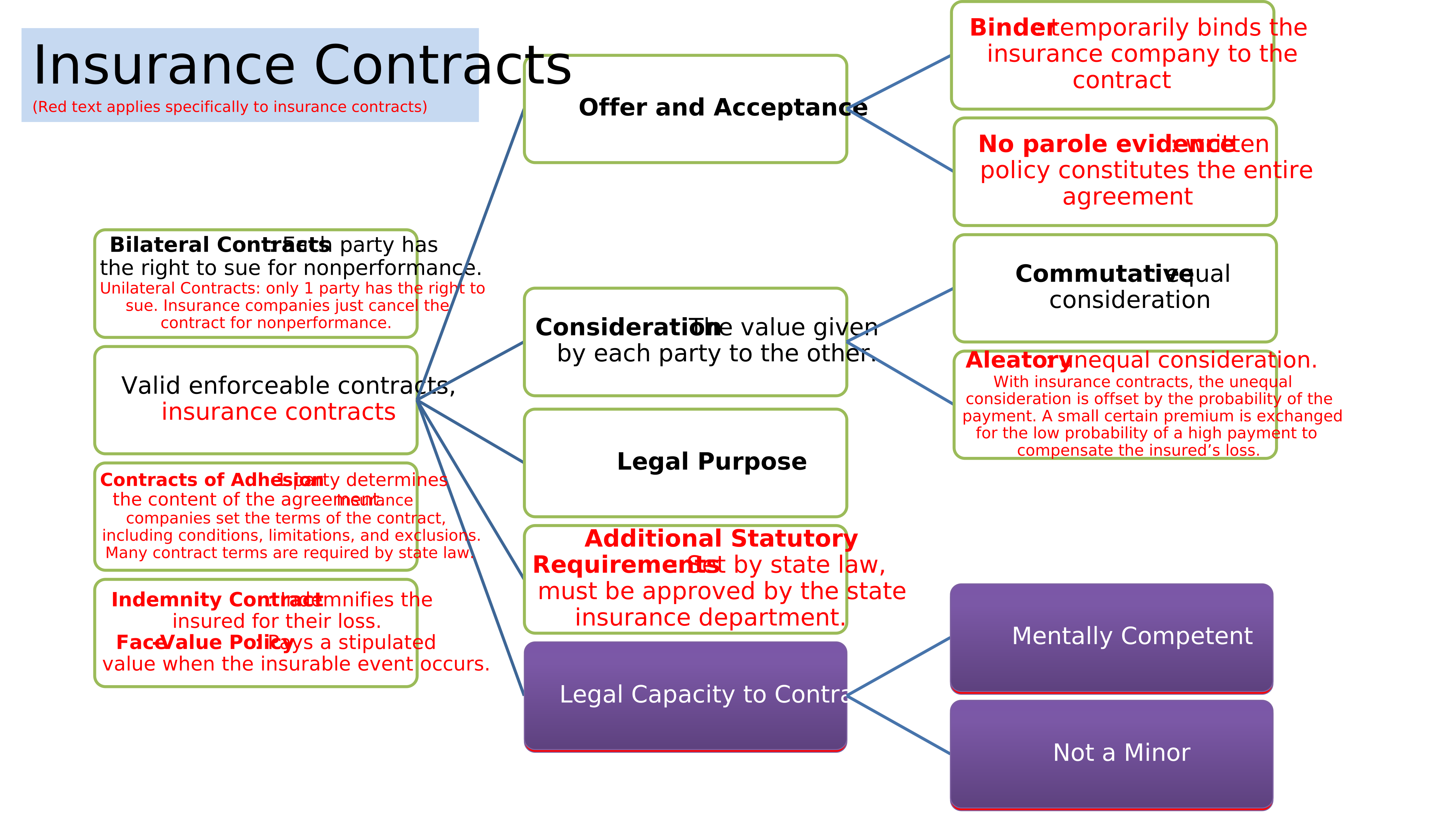
A valid contract, including insurance contracts, has 4 requirements:
- offer and acceptance,
- consideration,
- competent parties, and
- legal purpose.
Insurance contracts have an additional requirement that they be in legal form. Insurance contracts are regulated by state law, so insurance contracts must comply with these requirements. The state may stipulate that only certain forms may be used for certain types of insurance or that the contract must have certain provisions. Additionally, contracts must be approved by the state insurance department before they can be used, to ensure they comply with regulations.
If a contract lacks any of these essential elements, then it is a void contract that will not be enforced by any court. For instance, most contracts signed by a minor are void contracts because minors are not legally competent. A voidable contract can be nullified by a party if the other party breaches the contract, or because material information was false or omitted in the contract. The party with the right to void can also choose to enforce it, instead. For instance, insurance companies can often void a contract because the applicant provided false information on the application. Thus, if someone was in an auto accident, and that person previously filled out the insurance application stating that he had no speeding tickets, when, in fact, he had, then the insurance company can void the contract and not pay the claim. Though most contracts can be oral, most are written, especially insurance contracts, due to their complexity.
Offer and Acceptance
In insurance, the offer is typically initiated by the insurance applicant through the services of an insurance agent, who must have the authority to represent the insurance company, by filling out an application for insurance. Sometimes the application for insurance can be filed directly with the insurance company through its website. How the offer is accepted depends on whether the insurance is for property, liability, or life insurance. For property and liability insurance, the offer is the application for insurance and the payment of the 1st premium, or the promise to do so. In most personal lines of insurance, the agent can accept the offer for the company, binding the company to the contract.
A binder is a temporary contract that can be oral or written that binds the insurance company to the contract immediately until it can examine the application and issue a formal policy. Through the binder, the insurance becomes effective immediately. Most binders are written and include general information, such as the type and amount of insurance, the name of the parties, and the time during which the binder is effective. However, once a formal policy is issued, then the terms of the policy override the binder. This is particularly true for oral binders, for once a written policy is issued, the parole evidence rule makes the written policy determinative where there is any conflict between the oral and written agreement. If a mistake was made in the policy, such as mistyping the wrong policy value, then the contract can be reformed by correcting the mistake to prevent unjust enrichment of either party.
However, some agents cannot bind the insurance company, in which case, the insurance company must receive and accept the application, or it can reject it. The insurance is not effective until the company accepts the application.
In life insurance, the agent never has the power to bind the company. The applicant fills out the application and pays the 1st premium. The applicant is then given a conditional premium receipt — the most common type of receipt is the insurability premium receipt. If the applicant is insurable under the company's underwriting standards, the life insurance becomes effective from the date of the application or the medical examination.
However, if the premium is not paid when the application is filled out, then the insurance will not become effective until the policy is delivered and the premium is paid, and the applicant is in good health when the policy is delivered. Some companies require that the applicant not receive any medical treatment between the application and the delivery of the policy; otherwise the policy will not become effective.
Thus, a conditional receipt is like a binder, but differs from it because coverage is conditional upon the health of the applicant, occupation, and other factors. A binder does not require the payment of a premium to become effective — often the insurer needs the time to determine what the premium will be.
Contracts of Adhesion
While the insurance applicant is considered the one making the offer, the insurance company dictates the terms of the contracts. The insurance applicant must accept the contract of adhesion totally or not at all. With differing legal definitions and rulings provided by different courts in the past and requirements imposed by state governments and their agencies, an insurance contract must be carefully worded to be legally effective and to provide coverage as intended. This is why insurance contracts offered to the public are standardized. Another reason is because insurance companies can only calculate competitive premiums based on actuarial studies, and these studies are based on certain limits and underwriting guidelines. Thus, most insurance contracts cannot be negotiated. However, the insured can request specific riders and exclusions to the policy. A rider (aka endorsement) is an amendment or addition to the basic policy that allows the policy to be tailored in acceptable ways for individual situations. An exclusion is a loss not covered by the contract.
Because most insurance contracts are not negotiable, the courts have created case laws to benefit the insured. The first law, applicable to contracts generally, is that where there is an ambiguity in a contract, the ambiguity is construed against the maker of the contract, which, in insurance, is the insurance company. Thus, if the terms of a contract are not specific, then the terms are interpreted in a way that would most benefit the insured. Case law has also instituted the principle of reasonable expectations, requiring that any exclusion or other qualification be conspicuous; otherwise, the insured is entitled to coverage that he reasonably expects.
Life insurance and some health insurance contracts usually have entire contract clauses that require the attachment of any statements, including the application, made by the insured to the contract itself, to prevent any disputes later. Entire contract clauses also prevent incorporation by reference, which is alluding to other written works, such as the corporate bylaws, that the insurance applicant hasn't read.
Personal Contracts
Property insurance contracts are personal contracts between the insured and the insurer. Property insurance covers the insured for the financial losses of property damage or loss, not the property itself. If the insured sells the property, the insurance does not transfer with it. The insurance cannot be assigned to anyone else without the insurer's consent. If property and liability contracts could be freely assigned, then someone who presents a low risk for the covered loss could buy a policy and sell it or give it to someone with a higher risk, rendering the premium inadequate to cover the greater loss exposure. For instance, a parent could buy automobile insurance for himself, then assign the policy to his teenage child, who would otherwise pay a higher rate since teenagers have a higher accident rate than other groups.
On the other hand, life insurance policies can be freely assigned, because the person insured remains the same. Indeed, many people who have acquired a terminal illness have sold their life insurance policies to 3rd parties to get money to treat their illness or to provide care.
Beneficiaries can be changed, because changing beneficiaries does not change the insured risk, so there is no consequence to the insurer if the policy owner changes the beneficiaries, but the insurer must be notified before the change has any legal effect, to protect the insurance company from paying the wrong person or from being forced to pay twice.
Consideration
Consideration is the value the parties to a contract give to each other — it is why the contract is agreed to. In insurance contracts, the insurer promises to pay for covered losses that the insured suffers, and the insured promises to abide by the contract and pay the premium. Most non-insurance contracts are bilateral contracts where the promises that each party makes are enforceable by the other party through legal proceedings. However, insurance contracts are unilateral contracts, where only the insurer makes a legally enforceable promise to pay for covered losses. The company cannot sue the insured for breach of contract. However, insurance contracts are also conditional contracts — if the insured fails to pay the premium, or fails to abide by the contract, then the insurer is not obligated to pay for any of the insured's losses.
Most non-insurance contracts are commutative contracts — the amount of consideration given by both parties are usually fairly equal. Thus, a contract to purchase real estate usually requires a payment equal to its value. Insurance contracts are, however, aleatory contracts, because the insurance company must pay only if certain events occur. If they don't occur, the company never has to pay, even if the insured has paid premiums for decades. However, if a covered loss does occur, then the insurance company may have to pay much more than it has collected in premiums. Thus, aleatory contracts are characterized by unequal consideration.
Competent Parties
The parties to the contract must be legally competent to form an agreement. Most adults have legal capacity to agree to contracts, unless they are intoxicated, mentally ill, or mentally retarded. The key requirement is the parties must know what they are agreeing to — a meeting of the minds; otherwise, there could be no agreement. To protect minors, the law does not give them legal capacity to agree to contracts except where specified by law.
An insurance company has legal capacity if it is licensed to sell insurance in that particular state, and is acting within the scope of its charter.
Legal Purpose
All contracts must have a legal purpose to be enforceable by the courts, and, of course, insurance contracts do.
Performance and Discharge of Insurance Contracts
The performance required of most insurance contracts is for the insured to pay premiums and perform any other duties required by the contract, while the insurer's main duty is to pay for losses, if any occur. Most insurance contracts, such as policies for property, liability, and health insurance, are indemnity contracts, where the insurance company is only required to compensate for actual losses, up to the policy limits. However, some contracts, such as life insurance policy contracts, pay the face amount of the policy. Besides that the insured must pay the premium to the insurer, neither party needs to perform until a loss occurs, but when a loss does occur, then the insured must initiate performance before the insurer is required to do anything.
Insurance contracts require the insured to perform specific things or requires certain conditions, both before and after a loss, which the law sometimes categorizes as conditions precedent and conditions subsequent. If the insured fails to perform these duties or satisfy these conditions, the insurance company may be relieved of its obligation to pay the claim for the breach of contract. However, courts in most jurisdictions will only grant relief to an insurer's obligation to pay a claim if the breach is material.
A condition precedent is either a condition that must be satisfied or something the insured must do either before or when a loss occurs and before the insurer will perform, usually by paying the claim. If the insured does not satisfy a material condition precedent, then the insurer may be relieved of paying the claim. Some common conditions precedent include:
- requiring the insured to notify the insurer of any loss;
- property insurance requiring the insured to provide an inventory of the losses;
- disability insurance requiring the insured to submit proof of disability to the insurer.
A condition subsequent is a condition that must be fulfilled after an event requiring an act by the insurer. Example: if the insurance company wants to exercise its subrogation rights and sue a 3rd party for the insured's cause of loss, then the insurer may require the insured to testify in court.
What Is the Real Distinction between Condition Precedent and Condition Subsequent?
I have simplified the discussion about condition precedent and condition subsequent for the variation and confusion as to how these terms are used.
A primary source of confusion is what constitutes the dividing line between condition precedent and condition subsequent, the event dividing the before from the after. Regarding insurance contracts, is that the loss event or when the insurance company pays the insured? Courts have differed in deciding what event separates a condition precedent from a condition subsequent. Some have held that all the conditions specified could be classified as condition precedents since this is what the contract requires.
A common definition of a condition subsequent is any condition that frees one party from having to fulfill the contract. So, if an insured suffers a loss where the insurance company requires stipulated proof for the loss, the insured must provide the proof or the insurance company can deny payment, thus allowing it to opt out of paying for that loss.
Though the distinction between the 2 types of conditions may seem pedantic, how a condition is classified usually has legal consequences. For instance, if a court decides that an unfulfilled condition is a condition precedent, many jurisdictions require the insured to prove that the condition precedent had been satisfied, based simply on that classification; but if the condition is classified as a condition subsequent, many jurisdictions require the insurance company to prove that the condition was not satisfied, and that the unfulfilled condition harmed the insurance company.
What compounds the problem distinguishing between these 2 types of conditions is that their definition and treatment by the courts will differ with jurisdiction. It makes much more sense to simply place the burden of proof on the party who can most easily present the proof and not worry about the semantic distinction between condition precedent and condition subsequent since it is obvious that all required conditions, regardless of their classification, must be satisfied for the parties to be obligated to complete their performance requirements.
Insurance contracts can be ended by mutual agreement — recission. The insured can terminate the contract by not paying the premium. If the insurance company has evidence of fraud, it can ask a court to rescind a contract unilaterally. However, life insurance policies usually have an incontestable clause which prevents an insurer from canceling a life insurance policy after a 1- or 2-year period. The initial period gives the insurance company time to check the facts in the application, and possibly rescind the contract if it detects fraud. However, after this period, the life insurance cannot be canceled by the company for any reason other than nonpayment of the premium.