Portfolios Returns and Risks
A portfolio is the total collection of all investments held by an individual or institution, including stocks, bonds, real estate, options, futures, and alternative investments, such as gold or limited partnerships.
Most portfolios are diversified to protect against the risk of single securities or class of securities. Hence, portfolio analysis is analyzing the portfolio as a whole rather than relying exclusively on security analysis, the analysis of specific securities. While the risk-return profile of a security depends mostly on the security itself, the risk-return profile of a portfolio depends not only on the component securities, but also on their mixture or allocation and on their degree of correlation.
As with securities, the objective of a portfolio may be for capital gains or for income, or a mixture of both. A growth-oriented portfolio is a collection of investments selected for their price appreciation potential, while an income-oriented portfolio has investments selected for their current income of dividends or interest.
The selection of investments depends on one's tax bracket, need for current income, and tolerance for risk, but regardless of the risk-return objectives of the investor, it is natural to want to minimize risk for a given level of return. The efficient portfolio consists of investments providing the greatest return for the risk, or — alternatively stated — the least risk for a given return. To assemble an efficient portfolio, one needs to know how to calculate the returns and risks of a portfolio, and how to minimize risks through diversification.
Portfolio Returns
Since the return of a portfolio is commensurate with the returns of its individual assets, the return of a portfolio is the weighted average of the returns of its component assets.
| Portfolio Return | = | n ∑ k=1 | Dollar Amount of Asset k Dollar Amount of Portfolio | × | Return on Asset k |
n = number of assets
The dollar amount of an asset divided by the dollar amount of the portfolio is the weighted average of the asset and the sum of all weighted averages = 100%.
Example: Calculating the Expected Return of a Portfolio of 2 Assets
| Asset Weightings | |
|---|---|
| Asset A | 30% |
| Asset B | 70% |
| Expected Returns for each Asset | |
| E(rA) | 13.9% |
| E(rB) | 9.7% |
The expected return of this portfolio is calculated thus:
Portfolio Expected Return = .3 × .139 + .7 × .097 = .109 = 10.9%
Portfolio Risk, Diversification and Correlation Coefficients
Portfolio risks can be calculated, like calculating the risk of single investments, by taking the standard deviation of the variance of actual returns of the portfolio over time. This variability of returns is commensurate with the portfolio's risk, and this risk can be quantified by calculating the standard deviation of this variability. Standard deviation, as applied to investment returns, is a quantitative statistical measure of the variation of specific returns to the average of those returns. One standard deviation = the average deviation of the sample.
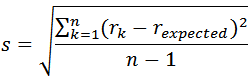 |
- s = Standard Deviation
- rk = Specific Return
- rexpected = Expected Return
- n = Number of Returns (sample size)
- n − 1 = number of degrees of freedom
- in statistics, used for small sample sizes
Though the diversifiable risk of a portfolio obviously depends on the risks of the individual assets, it is usually less than the risk of a single asset because the returns of different assets rise or fall at different times. Hence, portfolio risk can be reduced by diversification — choosing individual investments that rise or fall at different times from the other investments in the portfolio. For most portfolios, diversifiable risk declines, quickly at first, then more slowly, reaching a minimum with about 20 - 25 securities. However, how rapidly risk declines depends on the covariance of the assets composing the portfolio.
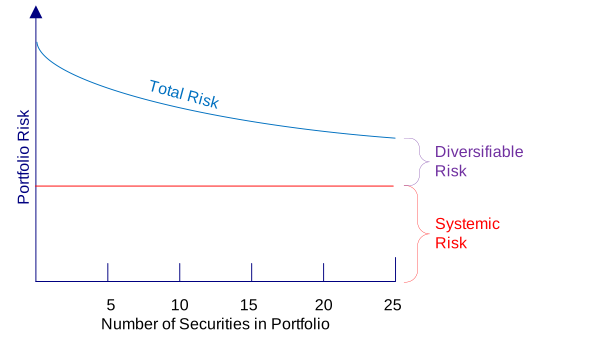
Portfolio risk has 2 components: systemic risk and diversifiable risk. Systemic risks, aka systematic risks, are risks affecting all assets, such as general economic conditions, and, thus, systemic risk is not reduced by diversification. Diversifiable risks are risks specific to particular assets, such as factors affecting particular businesses and their stocks. Diversifiable risks can be reduced to the extent that the coefficients of correlation of the assets in the portfolio approaches 0.
Total Portfolio Risk
- = Systemic Risk
- + Diversifiable Risk
The basis for diversification is that different classes of assets respond differently to different economic conditions, which causes investors to move assets from 1 class to another to reduce risk and to profit from changing conditions. For instance, when interest rates rise, stocks often decline as margin interest rises, making it more expensive to borrow money to buy stocks, which lowers their demand, and therefore their prices, while higher interest rates also cause investors to move more money into less risky securities, such as bonds, that pay interest.
Covariance is a statistical measure of how 1 investment moves relative to another. If 2 investments move up or down during the same time periods, then they have positive covariance. If the highs and lows of 1 investment move in perfect coincidence to another investment, then the 2 investments have perfect positive covariance. If 1 investment is up while the other is down, then they have negative covariance. If the high of 1 investment coincides with the low of the other, then the 2 investments have perfect negative covariance. The risk of a portfolio composed of these assets can be reduced to zero. If the up and down cycles of 1 investment compared to another has no discernible pattern, then the 2 investments have no covariance.
Because covariance numbers cover a wide range, the covariance is normalized into the correlation coefficient, which measures the degree of correlation, ranging from -1 for a perfectly negative correlation to +1 for a perfectly positive correlation. An uncorrelated investment pair would have a correlation coefficient close to zero. Note that since the correlation coefficient is a statistical measure, a perfectly uncorrelated pair of investments will rarely, if ever, have an exact correlation coefficient of zero.
The most diversified portfolio has securities with the greatest negative correlation. A diversified portfolio can also be achieved by investing in uncorrelated assets, but there will be times when the investments will be both up or down, and thus, a portfolio of uncorrelated assets will have a greater degree of risk, but still significantly less than positively correlated investments. However, even positively correlated investments will be less risky than single assets or perfectly positively correlated investments. Risk is not reduced by combining perfectly correlated assets.
Correlations can change over time and in different economic conditions. For instance, during the late 1990's, stock prices increased significantly, then crashed in 2000. Interest rates were lowered to boost the economy, which caused real estate prices to increase significantly from 2001 - 2006. Hence, real estate prices were increasing while stocks were either declining, or not increasing by nearly the same rate. This reflects the general negative correlation between the stock market and the real estate market. The real estate market was forming a bubble due to the extremely low interest rates at the time. The bubble finally burst in 2007, and especially 2008, leading to the 2007 – 2009 Great Recession. This caused money to move into commodities during the summer of 2008, which formed another bubble, with oil prices, for instance, reaching $147 per barrel. The fast increase in prices was not due to demand, but to the transfer of money from assets doing poorly — stocks and real estate — to commodities and future contracts. In other words, it was another bubble. However, as credit dried up, due to the prevalence of many defaults of subprime mortgages, almost every investment came crashing down in September and October of 2008: real estate, stocks, bonds, commodities. Only United States Treasuries, which are free of credit-default risk, rose significantly in price, driving their yields down proportionately, with the yields of short-term T-bills reaching almost zero.
During the Covid-19 recession of 2020, assets of all types declined significantly in price as people sold their assets to get cash to pay their bills since many of them were unemployed due to the Covid-19 pandemic. However, world governments reacted strongly by providing credit and money to support their economies, so the assets quickly regained, and even surpassed, their previous prices.
So the corollary of this story is that correlations can and do change, and that investments always have some risk.
Calculating the Covariance and Coefficient of Correlation between 2 Assets
In this section, we will actually calculate the covariance and the coefficient of correlation between 2 assets, which is the simplest case, based on this table:
| Economic State | Probability of State | Asset A Return (%) | Asset B Return (%) |
|---|---|---|---|
| Boom | 20% | 22 | 6 |
| Normal | 55% | 14 | 10 |
| Recession | 25% | 7 | 12 |
The variance of an asset A is calculated thus:
| σ2 | = | S ∑ s=1 | Ps{[rAs − E(rA)]2 |
- σ2 = Variance of Asset A
- S = Number of Different States
- (i.e., Boom, Normal, Recession)
- Ps = Probability of Economic State s
- rAs = Return for Asset A for the sth period.
- E(rA) = Expected Return for Asset A
Risk is typically represented by the standard deviation of the expected returns of an asset, equal to the square root of its variance:
Standard Deviation = √σ2
To calculate variances for the 2 assets, the probability of each state is multiplied by the return for that state minus the expected return squared. The expected returns for these 2 assets were calculated in the 1st example at the top of the page:
| Expected Returns | |
|---|---|
| E(rA) | 13.9% |
| E(rB) | 9.7% |
| σ2A | = | .2 × (22 − 13.9)2 + |
| .55 × (14 − 13.9)2 + | ||
| .25 × (7 − 13.9)2 | ||
| = | -25.03 |
| σ2B | = | .2 × (6 − 9.7)2 + |
| .55 × (10 − 9.7)2 + | ||
| .25 × (12 − 9.7)2 | ||
| = | -4.11 |
| Variances of Returns (%) | |
|---|---|
| σ2A | 25.03 |
| σ2B | 4.11 |
Covariance is measured over time, by comparing the expected returns of each asset for each time period. The time periods are selected for the different states of the economy, comparing the expected returns of each asset during boom times, recessions, and normal times. Though returns can be selected according to other criteria, such as monthly returns, it makes sense to sample the returns based upon different states of the economy since this is more likely to reveal their covariance.
| σAB | = | S ∑ s=1 | Ps{[rAs − E(rA)][rBs − E(rB)]} |
- σAB= Covariance of Asset A with Asset B
- S = Number of Different States (i.e., Boom, Normal, Recession)
- Ps = Probability of Economic State s
- rAs = Return for Asset A for the sth period.
- rBs = Return for Asset B for the sth period.
- E(rA) = Expected Return for Asset A
- E(rB) = Expected Return for Asset B
The covariance of 2 assets = the probability of each economic state multiplied by the difference of the return for each asset for each economic state minus the expected return for that asset. The covariance of these 2 assets, based on the table above, is:
| σAB | = | .2 × (22 − 13.9) × (6 − 9.7) + |
| .55 × (14 − 13.9) × (10 − 9.7) + | ||
| .25 × (7 − 13.9) × (12 − 9.7) | ||
| = | −9.95 |
The coefficient of correlation between Asset A and Asset B, designated as σAB, which can range from -1 to +1:
| σAB = | σAB σAσB |
Therefore:
| σAB = | σAB σAσB | = | −9.95 √25.03 √4.11 | = | −0.98 |
As the number of assets increases, the computational complexity greatly increases since covariance must be measured between every 2 different assets in a portfolio, which leads to (n2 − n) / 2 covariance calculations, where n = number of assets in the portfolio, in addition to the calculations of the expected returns and variances for each asset. The number of covariance calculations is divided by 2 because the covariance of Asset A to Asset B is the same as the covariance of Asset B to Asset A. To avoid this complexity, simplifying models are used. The simplest of these models is the single-index model, which can approximate the covariance of assets in a portfolio by comparing the variance of each asset with the variance of the market.