The Option Greeks: Delta, Gamma, Theta, Vega, and Rho
Because the price of options depends on the price of the underlying asset and because options are a wasting asset due to their limited lifetimes, option premiums vary with the price and volatility of the underlying asset and time to expiration of the options contract. Several ratios have been developed to measure this change in price with respect to the price or volatility of the underlying and measures time decay. Since most of these ratios are represented by Greek letters — delta, gamma, theta, and rho — the group is often referred to simply as the greeks. Vega is also a commonly used ratio and is also considered a greek, although it is not actually a Greek letter (some purists prefer to use the Greek letter tau for vega). These ratios are used to measure potential changes in the value of an actual portfolio or of test portfolios of options from potential changes in the underlying stock price, volatility, or time until expiration.
Delta (aka Hedge Ratio)
The delta ratio is the percentage change in the option premium for each dollar change in the underlying. For instance, if you have a call option for JXYZ stock with a strike price of $30, and the stock price moves from $30 to $31, it will cause the option premium to increase by a certain amount — let's say it increases by $.50. Then the option will have a positive delta of 50%, because the option premium increased $.50 for an increase of $1 in the stock price. Rather than specifying a percentage, delta is often denoted by a whole number, so if an option has a 50% delta, then it often is denoted as "50 delta". Note that a put option with the same strike price will decline in price by almost the same amount, and will therefore have a negative delta.
Options are frequently used to hedge risk. For instance, if you have 100 shares of JXYZ stock, priced at $30 per share in October, and you expect the price to rise dramatically after earnings are reported, then you may want to sell after the move up to lock in your profits. But what if earnings are less than what the market expected. Then the price may drop, resulting in a loss. To protect your position, you buy some JXYZ puts with a strike price of $30 and an expiration in November that will increase in price as the stock drops in price, but how many options contracts should you buy? If the delta of the put is −50, then the put will increase in value by 50¢ for each $1 drop in the price of the stock, at least while it hovers around the strike price. Therefore, you would want to buy 2 put contracts to cover or hedge your position. Since each contract is an option to sell 100 shares of stock for the strike of $30, the total price of both contracts will increase by $1 for each $1 decrease in the stock price. However, for each increase of $1 in the stock price, the price of 2 shares of the put options will decrease by $1. Since the value of the portfolio doesn't change within a narrow range, it is said to be delta neutral, also called delta hedging. The delta of a portfolio, calculated by summing the deltas of each option in the portfolio, is its position delta.
Delta is also used as a proxy for the probability that a call will expire in the money. So a stock with a delta of 85 is deemed to have an 85% chance of finishing in the money. However, delta does not measure probability per se. Delta can serve as a proxy for the probability only because both delta and the probability that a call will go or stay in the money increases as the option goes further into the money. However, delta is not a direct measure of the probability. As an example of where delta and probability will diverge is on the last trading day of the option. Most of the value of a call depends on the intrinsic value, the amount that the underlying price exceeds the call strike price. If the underlying asset increases by $1, then a call must increase by nearly the same amount; otherwise, arbitrageurs could sell a stock short and buy the call to make a riskless profit. Therefore, on the last trading day, delta must be virtually 100% for an in-the-money call; nonetheless, it is still highly probable that the option can go out of the money in the remaining time, especially if volatility is high, as it often is on the last trading day of the option, so the probability the call will remain in the money is less than 100%.
Gamma
The above example will not work out perfectly in the real world. You may even ask, why adopt a delta neutral portfolio when your objective is to profit? Answer: the above strategy would protect your downside while still allowing you to profit from most of the upside.
A delta neutral portfolio is only delta neutral within a narrow price range of the underlying. Delta itself changes as the price of the underlying changes. For instance, in the above example, if earnings turn out to be better than expected, and JXYZ climbs to $36 per share, then the value of the puts will drop to 0. If you paid $2 per share for the puts, then your total cost for the puts was $400, which is what you will lose if the puts expire worthless. However, you will earn $600 from the sale of your JXYZ stock, for a net profit of $200. But, suppose JXYZ reported abysmal earnings and the price dropped to $25 per share instead. Then you would profit from the puts, but lose on the stock. So would the profit from the puts completely neutralize the loss on the stock? Actually, you would do better. Each put would be worth $5 per share, and since you have 200 shares, your profit from the puts would be $1,000 and your loss on the stock would be only $500 for a net of $500 minus commissions and premiums. This results because delta itself changed.
Gamma is the change in delta for each unit change in the price of the underlying. The absolute magnitude of delta increases as the time to expiration of the option decreases, and as its intrinsic value increases. Thus, in the above example, as the intrinsic value of the puts increased and time to expiration decreased, the delta of the puts decreased to almost -1, where each $1 drop in the price of the stock increased the price of each share of the puts by $1. The only way you would lose with this strategy is if the stock didn't do much of anything until expiration — then you would lose the premiums paid for the puts, but at least your loss was limited to the $400 dollars + commissions and premiums.
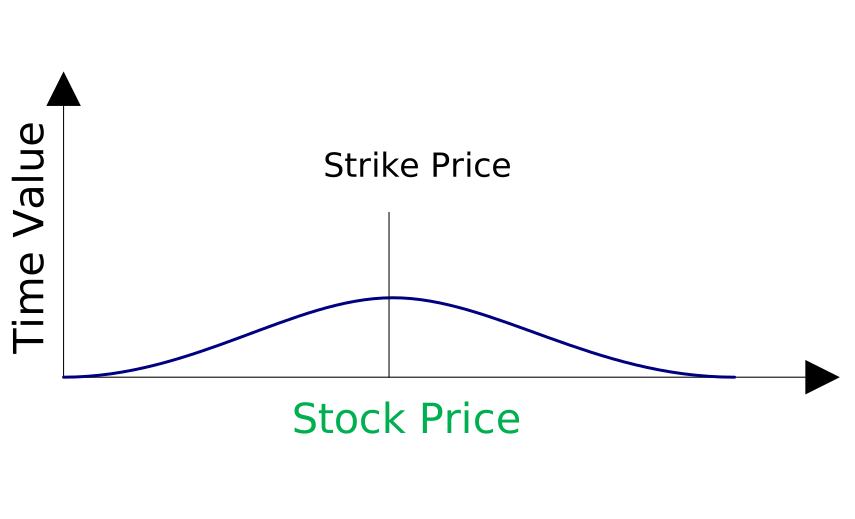
Gamma changes in predictable ways. As an option goes more into the money, delta will increase until it tracks the underlying dollar for dollar; however, delta can never exceed 1 or be less than -1. When delta is close to 1 or -1, then gamma is near zero, because delta doesn't change much with the price of the underlying. Gamma and delta are greatest when an option is at the money — when the strike price = the price of the underlying. The change in delta is greatest for options at the money, and decreases as the option goes more into or out of the money. Both gamma and delta decline as the stock price moves further from the strike price. The total gamma of a portfolio is called the position gamma.
Theta
Options are a wasting asset. The option premium consists of a time value that continuously declines as time to expiration nears, with most of the decline occurring near expiration. Theta measures this time decay and is expressed as the loss of time value per day. Thus, a theta of −.1 indicates that the option is losing $.10 of time value per day. Theta is minimal for a long-term option because the time value decays only slowly, but increases as expiration nears since each day represents a greater percentage of the remaining time. Theta is also greatest when the option is at the money, because this is the price where the time value is greatest, and, thus, has a greater potential to decay. For the same reason, theta is greater for more volatile assets, because volatility increases the option premium by increasing the time value of the premium. With higher volatility, an option has a greater probability of going into the money per unit of time. For the option writer, theta is positive, because options are more likely to expire worthless with less time until expiration.
Theta measures changes in the value of options or a portfolio due to the passage of time. The holding of options has a negative position theta because the value of options continuously declines with time. Because time decay favors the option writer, a short position in options is said to have positive position theta. The net of the positive and negative position thetas is the total position theta of the portfolio.
Vega (aka Tau)
Volatility is the variability in the price of the underlying over a given unit of time. The Black-Scholes equation includes volatility as a variable because it affects the probability of the option going into the money: higher volatility increases the likelihood. Historical volatility is easily measured, but current volatility cannot be measured because the unit of time is reduced to now. On the other hand, the price of the underlying, the option premium, time until expiration, and the other factors, except volatility, are known. Therefore, volatility can be measured by rearranging the Black-Scholes equation to solve for volatility in terms of the other known factors. This is called implied volatility, because the volatility is implied by the other known variables to the Black-Scholes equation. Consequently, vega is often used to measure the change in implied volatility.
Vega measures the change in the option premium due to changes in the volatility of the underlying, and is always expressed as a positive number. Because volatility only affects time value, vega tends to vary like the time value of an option — greatest when the option is at the money and least when the option is far out of the money or in the money. Vega measures how much an option price will change with a 1% change in implied volatility.
The position vega measures the change in option or portfolio values with changes in the volatility of the underlying.
Rho
Higher interest rates results in higher call premiums, according to option pricing models, because the present value of the strike price is subtracted in these models. Hence, higher interest rates correspond to lower present values, so less is subtracted, leading to higher call prices.
Prevailing Interest Rates,
Call Premiums
Put
Premiums
A more intuitive way to understand why higher interest rates increases call prices is to understand that a call is like a forward contract, in that it allows the holder to buy the stock at a specified price before the expiration date, so the money that would have been used to otherwise buy the stock can, instead, be invested in Treasuries to earn a risk-free interest rate until the date in which the stock is purchased. Because the stockholder incurs a cost of holding the stock, which is the forfeited interest that could otherwise be earned, a higher price is charged for the call to compensate the stockholder for the forfeited interest. By the same reasoning, dividends decrease the price of calls because only the stockholder is entitled to receive the dividends, not the call holder.
On the other hand, the application of the put-call parity theorem to option pricing models yields lower put premiums due to higher interest rates.
Rho measures the change in premiums due to a 1% change in the prevailing risk-free interest rate. Thus, a rho of 0.05 means that the theoretical value of call premiums will increase by 5%, whereas the theoretical value of put premiums will decrease by 5%, because put premiums move opposite to interest rates.
The values are theoretical because it is market supply and demand that ultimately determines prices. In fact, rho can be misleading because interest rates may have a larger effect on the price of the underlying, which is a more significant determinant of option prices. The demand for stocks, for instance, varies inversely with interest rates. When interest rates are low, investors buy stocks to earn more income. When interest rates rise, risk-averse investors move their money from stocks to safer bonds and other interest-paying investments. Thus, puts often increase with interest rates while calls decrease, because the price of the underlying will impact option premiums more significantly than the interest rate.