Real Estate Encumbrances: Deed Restrictions, Liens, Easements, and Encroachments
An encumbrance is a claim or liability against real estate, held by someone other than the fee owner of the property that affects the title to the property, and therefore its value. It does not confer any possessory interest, and therefore is not an estate, and does not necessarily prevent the transfer of title. Encumbrances can include property liens, deed restrictions, easements, profits à prendre (aka profits), and encroachments. Liens, easements, and profits are nonpossessory interests in real estate. Although a license to use land is also a nonpossessory interest, it is not an encumbrance, since it does not transfer with the land.
Deed Restrictions and Covenants
Deed restrictions, (aka conditions, covenants, and restrictions, or CC&Rs) are a common encumbrance, private agreements that restrict the use of the real estate in some way, and are listed in the deed— hence the name. The seller may add a restriction to the title of the property. Often, developers restrict the parcels of property in a development to maintain some uniformity. Deed restrictions also limit alterations or additions in historic districts, to maintain their historicity. Deed restrictions may be temporary or based on a covenant that runs with the land.
A covenant running with the land is a covenant that applies not only to the original parties but also to all their successors with an interest in the land. For a covenant running with the land to be enforceable, 4 requirements must be satisfied:
- the covenant must be created in a written document — usually the one used to convey the land
- the parties intend that the covenant run with the land
- the covenant must, as lawyers like to say, touch and concern the land, meaning that it alters the use of the property
- the successive parties with an interest in the land must be in privity of estate to the original parties that created the covenant, meaning that the relationship between successors to the land must be like the relationship between the original parties that created the covenant, such as seller and buyer or lessor and lessee.
Because the privity of estate requirement arbitrarily restricts the covenant to certain successors in interest, even though it should logically apply to all successors in interest, the courts have developed an alternative interpretation called equitable servitudes, based on all the requirements for a covenant running with the land except the privity of estate requirement. An equitable servitude is created by an instrument complying with the Statute of Frauds, stating that the use of the land is restricted, and giving notice of the restriction to any purchaser of the land. However, the notice can be constructive, in that the deed or other conveyance document can refer to the restriction. For instance, the restriction can be registered on a subdivision map and referenced by the deed.
Liens
A lien is a claim against the property which serves as collateral for a debt. The lien holder has the legal right to go to court to have the property sold to satisfy the debt, if it is not paid. Liens have priorities, so that when the property is sold, higher priority liens are paid before lower priority liens. The liens transfer with the property, so if they are not paid when the real estate is sold, then the new owner becomes liable for the debts.
Generally, earlier recorded liens have higher priority over later liens, but liens for taxes, assessments, and homeowner association fees have the highest priority, regardless of when they were recorded. Liens with higher priority are classified as senior liens, while lower priority liens are junior liens. After any liens for taxes, assessments, and association fees, 1st mortgages have the most senior lien, since loans to pay for property are not granted for properties without a clear title, meaning, in part, that there are no outstanding liens on the property. Besides unpaid debt collateralized by property, anyone who works on the property and is not paid can file a mechanic's lien. A judgment lien can also be assessed against property for liabilities unrelated to the property. So if a homeowner loses a court judgment for a car crash, the injured party can record a lien on the property for unpaid damages.
Easements
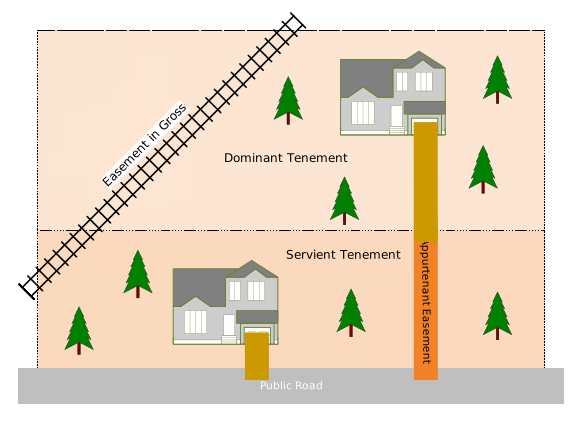
An easement is the right of someone other than a fee owner to use a particular parcel of land for a particular purpose — most often it is the right to cross the property. An appurtenant easement (aka appurtenance) is a right to use adjoining property that transfers with the land. The parcel of land that benefits from the easement is the dominant tenement, whereas the servient tenement is the parcel of land that provides the easement. The appurtenant easement always transfers with the land unless the owner of the dominant tenement releases it.
An easement in gross is an individual interest to use the land — it benefits a person or an organization, in contrast to an appurtenant easement, which is part of the land, and transfers with it. A personal easement in gross is used to allow a neighbor to cross someone else's land, but unlike an appurtenant easement, does not transfer with the property and ends when the owner of the easement dies.
Often, businesses, such as railways and phone companies, hold commercial easements in gross so that they can conduct business. Utility easements, which allow utilities to run electric wires or pipelines across properties, are also easements in gross. Commercial easements in gross can be assigned or conveyed.
The Creation of Easements
Easements are created by express agreement, by will, by deed, or by implication. Owners may create easements for themselves when selling parcels of their land or when giving easements to buyers of their property to pass over their land because of convenience or necessity.
One of the rights of owning land is to be able to enter or leave it, but some parcels of land are isolated from public thoroughfares by other private properties. In these cases, an appurtenant easement is created by a court order as an easement by necessity, because the dominant tenement owner has no other way of entering or leaving his property.
Sometimes the easement is created by implication, such as through long-time use or by prescription. An easement by prescription is created through long-term use, where the owner knew about the easement, but did not prevent its use. The length of time required is usually set by state law, typically 10 to 21 years, and the use must have been continual and without the owner's approval, but with the owner's knowledge. The required time period to establish the easement by prescription can be accomplished through tacking, where successive owners — successors in interest — of the dominant tenement continue to use the easement.
An easement by condemnation is created by eminent domain — owners of the servient tenement must, however, be compensated for providing the easement.
A party easement is created by written agreement between parties concerning a common boundary, such as a shared party wall, a fence, or a driveway, especially between adjacent townhouses or row houses.
The Termination of Easements
An easement can be terminated in several ways, especially when the reason for the easement no longer exists, or it makes no sense, such as when both dominant and servient tenements are bought by the same owner (termination by merger), or when the use of the easement changes significantly, for instance, by greatly increased traffic, or the owner of the dominant tenement releases the easement. An easement can be terminated if it is abandoned, but not if it is simply not used. But certain legal actions may be required before the easement is actually terminated.
Profits à Prendre
An easement allows a person to use a non-owned property but without taking anything from it. Much less common than easements but similar, profits à prendre — usually shortened to just profits — allows the holder to take something from a property, such as crops, soil, rocks, or minerals without owning the property. Profits, like easements, are classified either as appurtenant or in gross. Profits can be created or terminated like easements.
Licenses
A license, unlike an easement, is having the permission of the owner — the licensor — to enter his land for a specific purpose. Unlike an easement, the license can be rescinded at any time. For instance, if you purchase a ticket to a theater and are not dressed appropriately, then the facility manager can refuse your entry, because he can revoke your license to enter. A license will also terminate upon the death of either the licensee or the licensor, or if the licensor sells the land. Hence, although a license is like an easement, a license is not an encumbrance on the real estate and does not transfer with the title.
Encroachments
An encroachment is an extension of some physical structure, such as a building, driveway, fence, or tree over the property lines from an adjoining property. Encroachments can affect the marketing of the title, and should be noted in a listing agreement or sales contract.
Encroachments can best be determined by a spot survey, which is a survey showing the locations, sizes, and shapes of the buildings on a lot. Visual inspection is not as accurate and should not be relied upon if there is a question of an encroachment.
The owner of the land subject to the encroachment can either sue for damages or have the structure extending over the property lines removed or trimmed back. However, the owner of the encroaching structure may have an easement by prescription if the time period of the encroachment exceeds the prescriptive time stipulated by state law for an easement by prescription.