Tax Incidence: How the Tax Burden is Shared between Buyers and Sellers
Taxes are an important source of revenue for the government. However, taxes decrease both supply and demand in the market, because buyers have to pay a higher price and sellers receive a lower price for their product. Sometimes the government tries to divide the burden of the tax, such as the federal government does with the payroll tax, requiring both employer and employee to pay 1/2 of the tax which is 15.3% of wages paid.
However, do employers and employees actually pay only 1/2 of this tax? After all, if employers have to pay 1/2 of the payroll tax, then they can simply pay their workers less to compensate for their share of the tax. On the other hand, laborers can decide not to work for less than their disposable income, which is reduced by the burden of the payroll tax. As will be seen from considering the supply and demand and their elasticities, the actual tax incidence, defined as the actual burden that each transaction participant shares, cannot be mandated by law, but depends on the respective elasticities of both supply and demand on the taxed product.
To better see how the elasticity of supply and demand affects tax incidence, consider a 20% tax on a can of soda. Suppose the government decides that the buyer should pay the 20% tax. Does this mean that the buyers will be paying 20% more, or will sellers have to share some of the tax burden? Since higher prices decrease demand, regardless of why, sellers will share some of the burden. How much of the burden depends on the elasticity of supply and demand for the product.
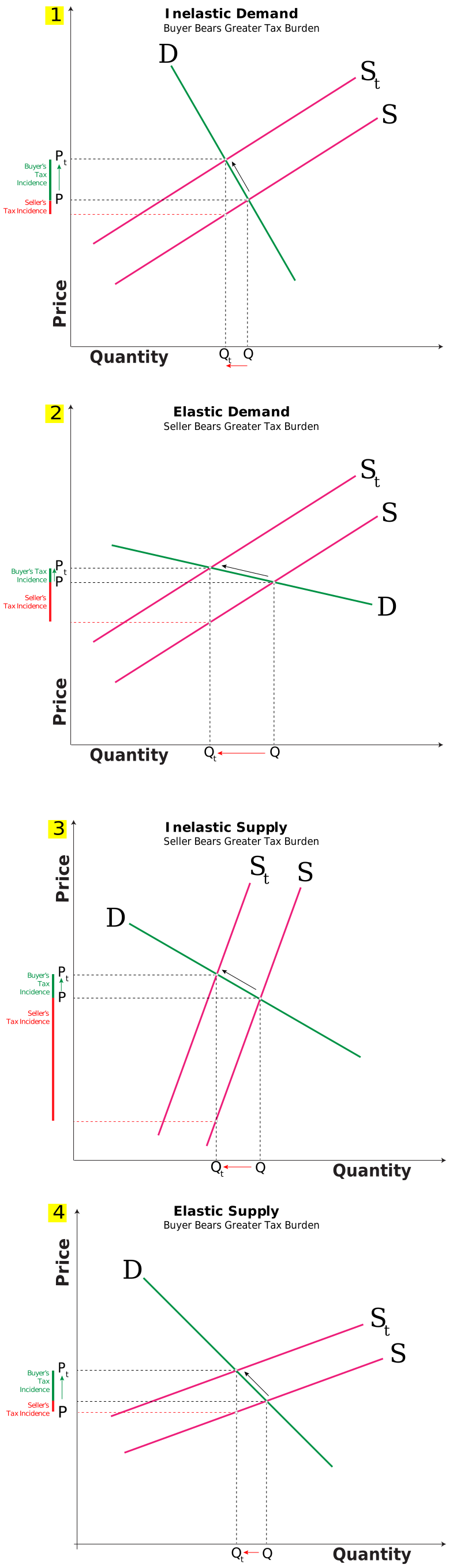
Only if either demand or supply was either completely elastic or inelastic will the tax burden fall entirely on either the buyer or the seller. Between these 2 extremes, tax incidence varies continuously from a perfectly inelastic supply or perfectly elastic demand, where the sellers assumes the entire burden of the tax to the perfectly elastic supply or perfectly inelastic demand where the buyers bear the entire burden. As can be seen in the diagrams below, the tax burden will fall more on the buyer if demand is inelastic or supply is elastic, but will fall more on the seller if demand is elastic or supply is inelastic.
Does a Tax Shift the Demand or Supply Curve?
The above diagrams shows how the tax incidence on buyer and seller is apportioned by a tax assessed on the seller by showing it as a shift in the supply curve caused by the tax. A similar argument can be made for a tax on the buyer. Some have argued that these shifts in the curves occur because the quantity supplied or demanded is less with the tax than without it.
A typical demand or supply curve shows the relation between the price and the quantity either demanded or supplied. The market equilibrium is where the 2 curves intersect. Any change in price results in a shift along the demand or supply curve. However, if demand or supply changes due to changes in other demand or supply determinants, then there is a shift in the demand or supply curve, where the quantity differs for every price point.
Some have argued that the buyer's tax causes a shift in the demand curve because the buyer buys less at each price. However, the traditional demand-supply diagram simply relates how quantities change relative to the price — regardless of why the price changed. The demand depends only on the price, not on who gets the money. Likewise, for sellers, the quantity supplied depends on the price they receive — that the buyer pays a higher price makes no difference to them. They supply per the schedule of the prices they actually receive.
Some argue that to determine the tax incidence of a tax, one must determine whether the demand curve or the supply curve has shifted, then find a new market equilibrium. However, I believe this unnecessarily complicates the analysis. A tax does not shift either the demand or the supply curve. The traditional supply-demand diagram tacitly assumes that the seller receives what the buyer pays. However, the imposition of the tax means that the buyer will pay more than what the seller receives — the difference goes to the government. Therefore, the demand and supply curve do not, in actuality, intersect. Instead, 2 new equilibria are created — the buyer's equilibrium price and the seller's equilibrium price. The tax incidence can still be measured by the elasticities of demand and supply, but it is unnecessary to shift either curve.
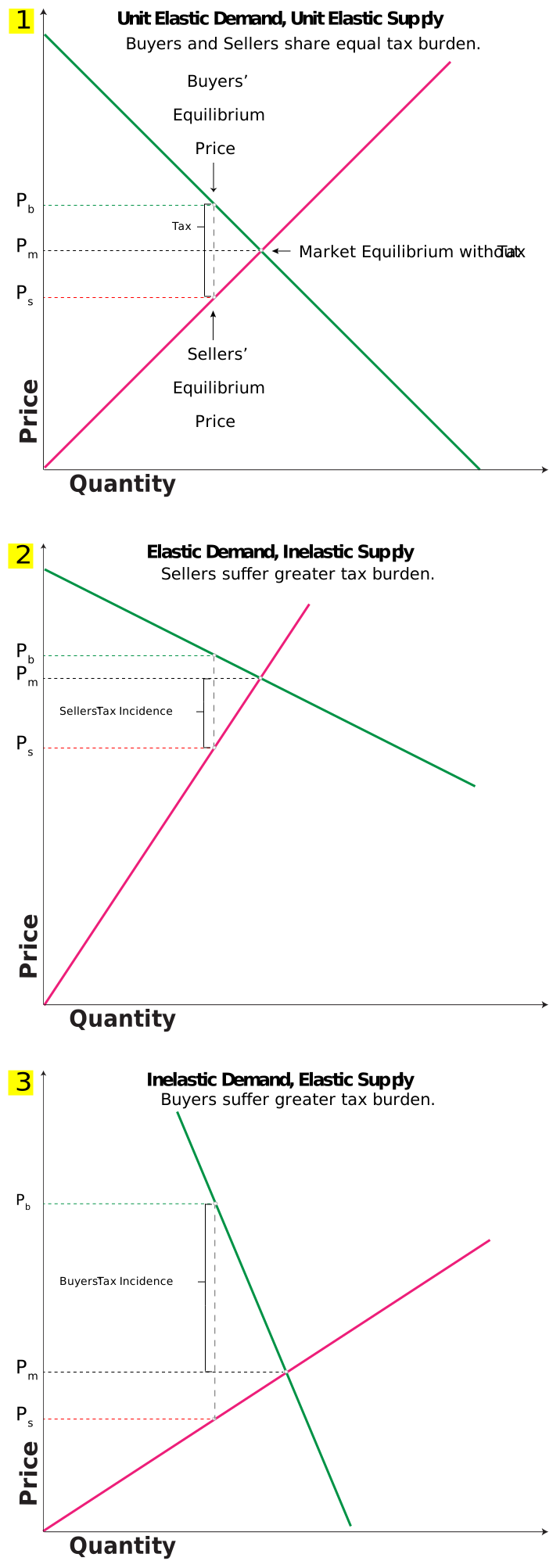
As can be seen in the graphs below, how the tax burden between buyer and seller varies with the elasticity of demand and supply can be shown without shifting either the demand or supply curve. In graph #1, buyer and seller share the tax burden equally since their elasticities are unitary. In graph #2, demand is elastic but supply is inelastic, causing most of the tax burden to fall on the seller. In graph #3, demand is inelastic but supply is elastic, causing the tax burden to fall mostly on the buyer.
Buyer's Tax Burden = Price Buyer Pays − Market Price without the Tax = Pb − Pm
Seller's Tax Burden = Market Price without the Tax − Price Seller Receives = Pm − Ps
Sales and Excise Taxes
The elasticity of demand is often considered when governments consider assessing sales or excise taxes on products or services. Because sales taxes are assessed on many items, buyers bear most of the burden of sales taxes since few other things can be bought tax-free. On the other hand, excise taxes, which are sales taxes on particular products, would, in many circumstances, hurt the sellers more because buyers can buy untaxed goods. This elastic demand pushes the tax burden on the sellers. However, some items, such as alcohol and tobacco, have no close substitutes, so demand is inelastic, so the tax burden for these items falls more on the buyers.
The Tax Incidence on Labor
In the labor market, labor is the supply and wages are the price of labor. Because the supply of unskilled labor is highly inelastic, unskilled workers bear most of the burden of the payroll tax.
However, workers with valuable skills are more highly compensated because there is more competition for their abilities and services. Thus, highly compensated individuals bear less of the burden of the payroll tax than the employers. The overall effect is that the tax incidence of the payroll tax falls more heavily on lower income workers than on higher income workers.
Personal Income Taxes
Most people must earn an income to live, so most taxpayers bear most of the burden of personal income taxes, though retail sellers and others selling directly to consumers will bear some of the burden in reduced sales since personal disposable income is reduced by income taxes.
Corporate Income Taxes
Corporations competing in a competitive market are price takers: their prices are determined by the market. Hence, corporations selling products or services in a competitive marketplace bear the burden of the income tax. However, corporations with monopoly power are price setters, allowing them to pass most of the cost of taxes onto consumers.
Property Taxes
The tax incidence of property taxes will fall on property owners, especially since property taxes are usually assessed annually. However, the tax incidence depends on tax rates of surrounding tax districts. Buyers will bear more of the tax incidence for properties in lower tax districts, while sellers will bear more of the incidence in higher tax districts. Likewise for rentals since property owners can charge higher rents in lower tax districts, while owners in higher tax districts must charge a lower rent for similar properties to compete.
Gratuitous Transfer Taxes
Gratuitous transfers are transfers to beneficiaries who give no consideration for the gift. In simple cases of gratuitous transfers, where taxes are assessed on the donee of the gift, the demand for the gift would be almost completely inelastic since the cost to the donee is nothing. (I say almost, because the donee may decline the gift if the value of the gift to her is less than the tax.) However, in the real world, and especially in the United States, the taxation of gratuitous transfers is more complicated. For instance, the federal government has no tax on inheritance, but it does have a tax on estates. It also has a tax on gifts, but gift taxes are paid by the donor — not the donee. Furthermore, the federal government provides a large unified credit that can be used to offset both estate and gift taxes, with the result that considerable wealth can be transferred tax-free. Nonetheless, we will examine some simple cases of gratuitous transfers.
Inheritance Taxes
Inheritance taxes are taxes assessed on beneficiaries of bequests and devisements. Although the federal government does not tax inheritance, many states do. Because beneficiaries do nothing to earn the bequest, the demand for the bequest is completely inelastic since a beneficiary will generally take whatever is given to her. Therefore, any inheritance tax will be borne entirely by the donee.
Gift Taxes
Whether gift taxes are assessed on the donor or the donee, the tax incidence is the same as it is for inheritance taxes since the donee gives no consideration for the gift, with the result that demand for the gift is inelastic.
Estate Taxes
Estate taxes are taxes assessed on the estates of decedents. Since every one must die eventually, the supply of death is completely inelastic. Therefore, the estate bears 100% of the tax.
Luxury Taxes
In 1990, Congress assessed a new luxury tax on goods generally sold to the wealthy, such as expensive cars, jewelry, yachts, private airplanes, and furs. The purpose of the luxury tax was to assess taxes on the segment of society that can most easily afford it. However, the wealthy can do many things with their money besides buying luxury items. They can travel around the world, move to places with lower taxes, host lavish parties, buy expensive houses, or give most of their wealth to their family members. Instead of taxing the wealthy, the luxury tax hurt the workers who provided the luxury products since their supply was inelastic. After all, the people who manufacture private airplanes or yachts have few other options for jobs. Likewise, these manufacturers cannot easily convert their facilities to produce something else, especially to produce lower-priced items that would appeal to the masses. So the manufacturers and the workers who provided the luxury goods paid most of the burden of the luxury tax. Subsequently, in 1993, Congress repealed the tax on airplanes and yachts, but not expensive cars since auto manufacturers can easily shift production to lower-cost vehicles.